
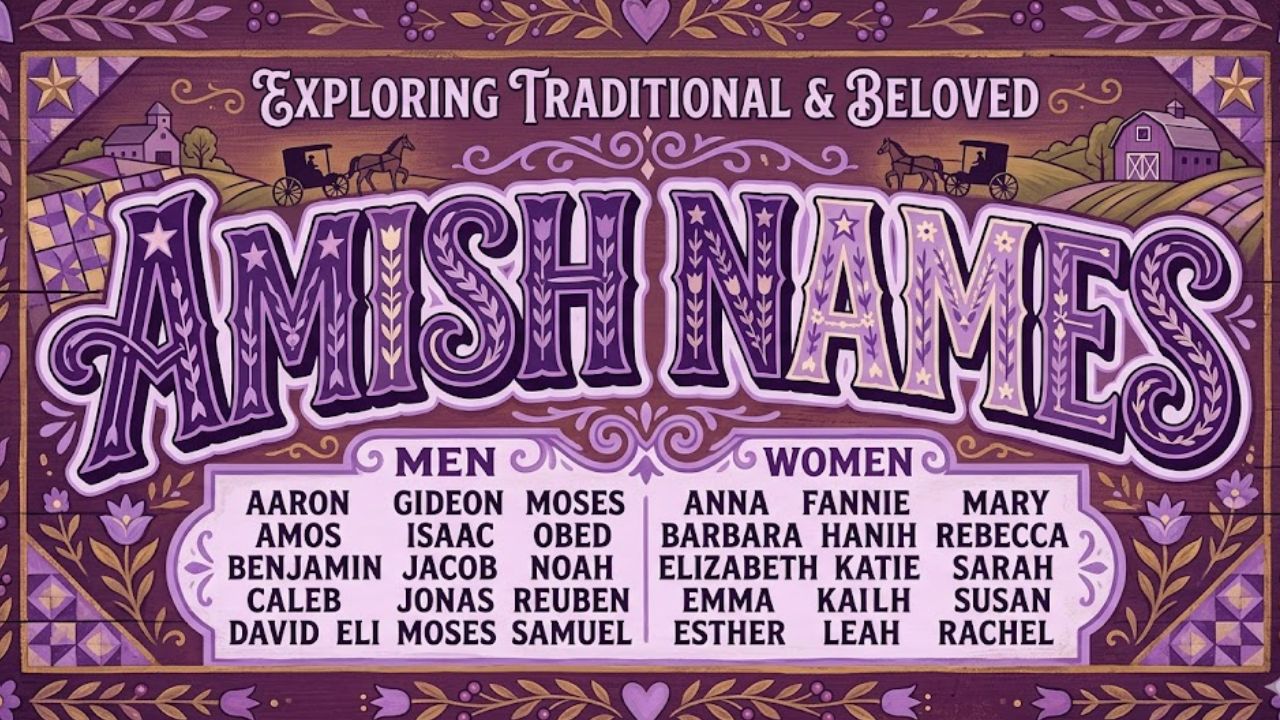
Have you ever heard a name so grounded and full of history that it stopped you in your tracks? Amish names carry that exact energy. They’re not trendy. They’re not flashy. But they hold something rare a living thread back to faith, family, and a community that has kept its values intact for centuries. Whether you’re searching for a baby name with genuine depth or just curious about this beautiful tradition, you’ve landed in the right place.
This article walks you through the most beloved Amish names for boys and girls, from deeply biblical picks to rare German gems you’ve probably never considered. You’ll find meanings, origins, and the cultural stories behind these names. These aren’t just names they’re legacies. So settle in, because what you’re about to read will completely change how you think about naming a child.
Classic Amish Names for Boys
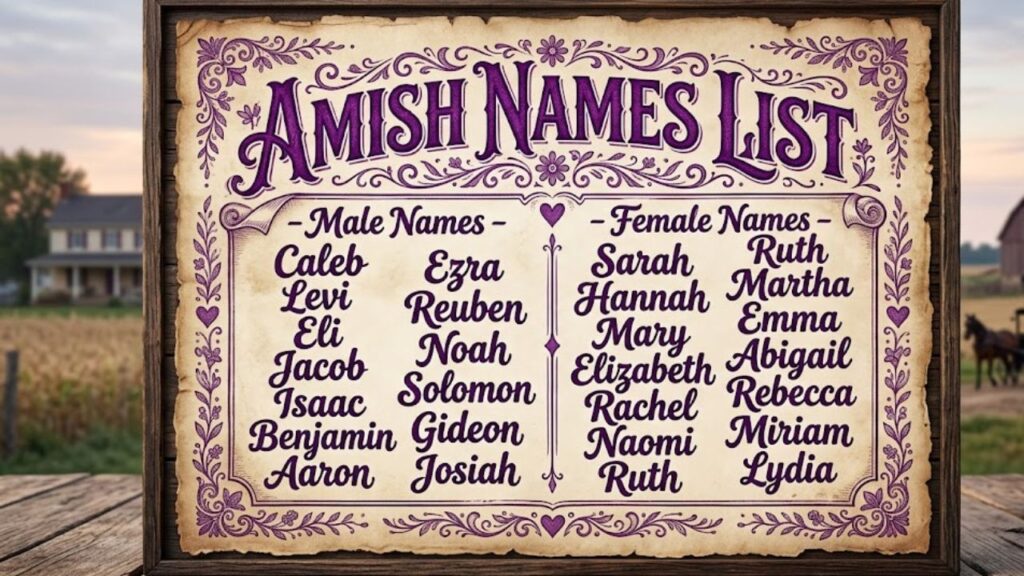
Amish names for boys draw almost entirely from the Old Testament and that tradition runs deep. These names weren’t picked for sound trends or celebrity influence. They were chosen to honor God, reflect virtue, and carry the memory of a grandfather or great-uncle forward into the next generation. Traditional Amish names for boys feel timeless precisely because they are.
- Biblical origin is the number-one priority for most Amish families when naming a son.
- Family continuity matters enormously firstborn sons often carry their father’s or grandfather’s name.
- Simple pronunciation is preferred names that are easy to say in both English and German.
- Occupational names like Fletcher and Tanner also appear in Amish communities with historical depth.
- Middle initials help distinguish multiple boys with the same first name within a community.
| Name | Origin | Meaning |
| Jacob | Hebrew | Supplanter, holder of the heel |
| Levi | Hebrew | Joined, attached |
| Samuel | Hebrew | God has heard |
| Elijah | Hebrew | Yahweh is my God |
| Jonas | Greek/Hebrew | Dove, peace |
- Aaron: Hebrew name meaning “exalted” or “mountain of strength,” honoring Moses’ elder brother and the first high priest of Israel.
- Abraham: A patriarchal powerhouse meaning “father of a multitude,” rooted in the very first covenant of the Old Testament.
- Amos: A strong, short Hebrew name meaning “borne by God,” carried by the shepherd-prophet of the Old Testament.
- Benjamin: Meaning “son of the right hand,” this beloved name suggests favor, closeness, and divine protection.
- Caleb: A Hebrew name full of courage, meaning “faithful” or “wholehearted devotion,” honoring the spy who trusted God’s promise.
- Daniel: From Hebrew meaning “God is my judge,” a name that carries quiet authority and unwavering faith.
- Elijah: Meaning “Yahweh is my God,” this thunderous prophet’s name remains one of the most beloved Amish baby names for boys.
- Ezra: A short, strong Hebrew name meaning “help,” representing a man who restores and rebuilds what matters.
- Gabriel: Meaning “God is my strength,” the name of the archangel who announced the birth of Christ revered across Amish communities.
- Gideon: A Hebrew warrior name meaning “mighty warrior” or “one who cuts down,” representing fearless leadership in faith.
- Isaac: Meaning “he will laugh” or “laughter,” a joyful name born from the miraculous birth of Abraham’s long-promised son.
- Jacob: Perhaps the most common of all Amish names, meaning “supplanter” a man who wrestled with God and walked away transformed.
- Jeremiah: Meaning “Yahweh will exalt,” this prophet’s name is warm, strong, and deeply embedded in Amish storytelling tradition.
- Jonas: A peaceful variant of Jonah, meaning “dove,” used widely across Amish settlements in Pennsylvania and Ohio.
- Joshua: Meaning “God is salvation,” a bold Hebrew name for a leader who kept his people moving forward.
- Josiah: A Hebrew royal name meaning “Yahweh supports,” connected to the boy-king who restored Israel’s covenant with God.
- Levi: Meaning “joined” or “attached,” this light, energetic name feels both biblical and refreshingly modern.
- Matthew: From the Hebrew Mattityahu, meaning “gift of God,” honoring the apostle who wrote the first gospel.
- Noah: Meaning “rest” or “comfort,” a universal name for the man who preserved life through faith when the world forgot how.
- Samuel: Meaning “God has heard,” the prophet whose name stands for prayer answered and purpose fulfilled.
- Silas: A Latin name meaning “forest” or “woods,” representing serenity, simplicity, and connection to the natural world values central to Amish life.
- Simon: Meaning “he has heard,” a name of listening, obedience, and quiet strength in community.
- Solomon: Meaning “peace” or “wisdom,” a royal name chosen by Amish families who value thoughtful, measured leadership.
- Timothy: A Greek name meaning “honouring God,” combining faith and elegance in a name that wears well across generations.
- Tobias: Meaning “God is good,” a warm, old-world name with both Hebrew and Greek roots, found in devout Amish households.
Beautiful Amish Names for Girls
Amish names for girls are modest, melodic, and meaningful. They don’t chase trends. They reflect virtues grace, faithfulness, purity, devotion. Many of these names come straight from the women of the Old Testament, women who showed courage and wisdom in quiet, powerful ways. Traditional Amish names for girls are having a quiet renaissance right now, and it’s easy to understand why.
- Old Testament women like Sarah, Rebekah, and Miriam inspire the most popular girl names.
- German diminutives add softness think Lena, Lina, and Bena.
- Family naming means daughters are often named after grandmothers or beloved aunts.
- Two-syllable names dominate, keeping the sound simple and graceful.
- Virtue names like Grace, Amity, and Hope blend faith with plain living.
| Name | Origin | Meaning |
| Sarah | Hebrew | Princess, noblewoman |
| Hannah | Hebrew | Grace, favor |
| Miriam | Hebrew | Beloved, wished-for child |
| Lydia | Greek | Noble one from Lydia |
| Esther | Persian/Hebrew | Star, hidden |
- Anna: A grace-filled Hebrew name meaning “favor” or “grace,” carried by the prophetess who recognized the infant Jesus.
- Esther: A Persian-rooted name meaning “star,” honoring the queen who saved her people through wisdom and bravery.
- Hannah: Meaning “grace” or “favor of God,” the name of a woman whose prayer was answered with the birth of Samuel.
- Leah: From Hebrew meaning “weary,” yet Leah’s story is one of quiet dignity and resilient love a name with real emotional weight.
- Lydia: A Greek name meaning “noble one,” connected to the businesswoman in Acts who opened her home to Paul.
- Mary: The most sacred name in Christian tradition, meaning “beloved” or “bitter,” carried by the mother of Jesus.
- Miriam: Moses’ sister and the first prophetess of Israel, this name means “beloved” or “wished-for child.”
- Naomi: Meaning “pleasantness,” a gentle Hebrew name whose owner showed loyalty and grace even through deep loss.
- Rachel: Meaning “ewe,” a symbol of gentleness Rachel was the beloved wife of Jacob and mother of Joseph.
- Rebecca: From the Hebrew Rivkah, meaning “to bind” or “captivating,” a strong matriarchal name rich in Old Testament history.
- Ruth: One of the shortest and most powerful Amish names for girls, meaning “companion” or “vision of beauty,” from the book of Ruth.
- Sarah: Meaning “princess” or “noblewoman,” the original matriarch of the Abrahamic faith beloved in every Amish community.
- Susanna: A Hebrew-rooted name meaning “lily,” soft yet striking, found in both the Old and New Testaments.
- Abigail: Meaning “my father’s joy,” a wise and gracious woman in the Old Testament who brought peace where others brought conflict.
- Delilah: Meaning “delicate” or “languishing,” a complex, beautiful name that has found quiet acceptance in some Amish families.
- Elisabeth: The classic German form of Elizabeth, meaning “my God is abundance” the name of John the Baptist’s mother.
- Eve: The very first name given to a woman in human history, meaning “life” or “living.”
- Grace: A simple virtue name that perfectly embodies the Amish ideal of living humbly and gratefully before God.
- Hilda: A German name meaning “battle woman” or “protector,” chosen by Amish families who value inner strength.
- Irene: Meaning “peace,” a Greek-origin name that carries exactly the spirit of Amish baby names for girls.
- Judith: Meaning “woman of Judea” or “praised,” the name of the brave woman who saved her people through courage.
- Kathryn: A Greek-rooted name meaning “pure” or “clear,” the Amish version of Katherine, often shortened to Katie.
- Lavina: A uniquely Amish variant of Lavinia, meaning “woman of Rome” rare and distinctive even within the community.
- Lena: A soft Persian-origin name meaning “light,” often used as a standalone name or as a diminutive of Helena.
- Martha: Meaning “lady” or “mistress of the house,” a practical, warm biblical name for the sister of Lazarus and Mary.
Unique Amish Names You’ve Never Heard Before
Not every Amish name is Jacob or Sarah. Some are genuinely rare used almost exclusively in Amish and Mennonite communities, invisible to the outside world. These traditional Amish names feel like secret treasures. They carry the depth of centuries without the familiarity of overuse. If you want something truly original with roots that go miles deep, these are the names worth knowing.
- Mennonite-exclusive names like Aganetha and Benuel are virtually unknown outside plain communities.
- Swiss German variants give common names an entirely different character and feel.
- Shortened nicknames in Amish communities often become standalone names over generations.
- Rare surname-turned-firstnames appear more in Old Order settlements than in mainstream culture.
- Regional variation matters names common in Lancaster County may be completely unknown in Holmes County.
| Rare Amish Name | Gender | Origin |
| Atlee | Boy | German (place-based) |
| Benuel | Boy | Hebrew/German blend |
| Aganetha | Girl | Greek (Agnes variant) |
| Saloma | Girl | Hebrew (Solomon variant) |
| Menno | Boy | German (Mennonite founder) |
- Atlee: A German-origin name derived from a place, meaning “meadow of oaks,” found almost exclusively in Old Order Amish communities.
- Benuel: A fascinating Hebrew-German blend name, a distinctive variant of Benjamin used nearly only among the Amish and Mennonites.
- Aganetha: A rare Greek-origin name derived from Agnes, meaning “pure” or “holy,” almost entirely unique to Mennonite and Amish women.
- Saloma: The feminine form of Solomon, meaning “peace,” an uncommon gem used in traditional Amish households for generations.
- Menno: Named after Menno Simons, the founder of the Mennonite faith a deeply meaningful name carried with quiet pride.
- Verena: A Swiss name of uncertain origin, thought to mean “integrity” or “truth,” particularly common in Swiss Amish settlements.
- Leander: Meaning “lion-man” from Greek, a surprisingly bold name found in certain Amish settlements across Indiana.
- Loisa: A traditional Amish variant of Lois, meaning “better” or “most desirable,” honoring the pious grandmother of Saint Timothy.
- Harley: An Old English occupational name meaning “hare’s meadow,” used in specific Amish regions with regional warmth.
- Mahlon: A Hebrew name meaning “sickness” or “dancing,” yet carried with grace it appears in the Book of Ruth as the name of Naomi’s son.
- Elmina: A feminine Amish variant of Elmo, blending German roots with a soft, melodic ending, rare even within the community.
- Aldous: A German-English name meaning “old” or “experienced,” suggesting wisdom earned through years of faithful living.
- Iddo: A rare Hebrew name meaning “evaporate” or “timely,” found in the genealogies of Chronicles and used in a handful of Amish families.
- Fannie: A beloved Amish nickname-turned-given-name, a warm variant of Frances meaning “free one,” common in Lancaster County households.
- Wollie: An Amish nickname for Wolfgang, a German name meaning “traveling wolf,” used with affection in plain communities.
- Annamae: A combined Amish given name blending Anna and Mae grace meeting pearl in a single warm, feminine name.
- Rufus: A Latin name meaning “red-haired,” used occasionally in Amish communities for its strong biblical association with Simon of Cyrene’s son.
- Elva: A soft German-origin feminine name meaning “elf” or “magical being,” used quietly in traditional Amish households.
- Uria: A Hebrew variant of Uriah, meaning “God is my light,” rare but reverently used in devout Old Order Amish families.
- Lovina: An Amish-specific feminine name blending love and Lavina, widely used in Pennsylvania Amish communities with deep affection.
- Eli: Short, powerful, and Hebrew meaning “ascended” or “uplifted,” a name that feels both ancient and perfectly at home today.
- Dorcas: A Greek name meaning “gazelle,” from the Book of Acts uncommon outside Amish and Mennonite communities.
- Phebe: An Amish spelling of Phoebe, meaning “bright” or “radiant,” from the Greek, honoring the woman praised in Paul’s letter to the Romans.
- Obadiah: A Hebrew name meaning “servant of God,” long, formal, and deeply biblical used by Amish families who honor their faith above fashion.
- Zilpah: The name of one of Jacob’s wives in Genesis, meaning “short-nosed” in Hebrew rare, ancient, and fascinatingly uncommon.
Amish Last Names and Their German Origins
Amish surnames are as much a part of identity as first names. They’re almost exclusively German in origin, reflecting the community’s roots among Swiss Anabaptists who fled persecution in the 16th and 17th centuries. These family names have survived intact because Amish communities rarely marry outsiders so the surnames stay concentrated, identifiable, and deeply linked to specific settlements and regions.
- Stoltzfus is the most iconic Amish surname in Lancaster County, meaning “proud foot” in German.
- Yoder is the most widespread surname across all American Amish settlements.
- Miller and Fisher are so common they appear in virtually every Amish community in North America.
- Schmucker, Beiler, Zook and Lapp are Lancaster County-specific surnames with deep local roots.
- Troyer, Hershberger and Raber dominate in Holmes County, Ohio’s large Amish settlement.
| Surname | Origin | Meaning |
| Stoltzfus | German | Proud foot |
| Schlabach | German | Lived by a brook |
| Kauffman | German | Merchant man |
| Schwartzentruber | German | Metal maker |
| Beiler | German | Barrel maker |
- Yoder: The most common Amish surname in America, of German-Swiss origin, believed to be derived from the name “Jodocus,” a Latin saint’s name.
- Stoltzfus: Meaning “proud foot” in German, this Lancaster County staple traces back to a single immigrant ancestor Nicholas Stoltzfus who arrived in 1766.
- Miller: The English adaptation of the German Müller, meaning “one who mills grain,” one of the most universal surnames in any Amish community.
- Fisher: From the German Fischer, meaning “fisherman” a simple, occupational surname with quiet resonance in communities of faith.
- Troyer: A German surname of Swiss origin, believed to mean “one from Troyes” dominant in Ohio’s Holmes County Amish settlement.
- Hershberger: A German place-name surname meaning “one from Hirschberg,” a mountain in the Swiss Alps reflecting the original homeland of many Amish families.
- Schlabach: Meaning “lived by a brook” a poetic, landscape-inspired surname that connects family identity to the natural world.
- Raber: A German surname connected to the word for “raven,” carrying a quiet, slightly mysterious character.
- Zook: A Swiss-German surname of uncertain origin, found almost exclusively in Lancaster County Amish communities.
- Lapp: A Lancaster County Amish surname believed to derive from the German word for “cloth” or “rag,” possibly an occupational name.
- Beiler: From a German word related to barrel-making, an occupational surname reflecting the craftsman heritage of Amish ancestors.
- Glick: A German surname meaning “luck” or “fortune” a short, cheerful name common in Lancaster and surrounding communities.
- Graber: Meaning “gravedigger” or “one who digs,” a German occupational surname used in Amish communities across multiple states.
- Hochstetler: A compound German surname meaning “high homestead,” tracing back to the Anabaptist martyr Jacob Hochstetler.
- Kauffman: Meaning “merchant man,” this commercially-rooted German surname reflects the trading history of the community’s European ancestors.
- Byler: A variant of Beiler, equally common in Pennsylvania and Ohio, sometimes interchanged within the same family across generations.
- Bontrager: A German-Swiss surname meaning “one from Bontragen,” a place in Switzerland deeply tied to the community’s geographic origins.
- Gingerich: A Swiss-German surname of uncertain origin, found primarily in Midwestern Amish settlements like those in Iowa and Indiana.
- Mast: A short, punchy German surname meaning “well-fed” or possibly “mast” as in a ship’s mast common in Ohio Amish communities.
- Schwartz: Meaning “black” in German, this surname appears in both Jewish and Amish communities, reflecting the shared Germanic heritage.
- Weaver: The English adaptation of Weber, meaning “one who weaves cloth” an occupational name that suits the Amish tradition of handcraft perfectly.
- Lantz: A German surname derived from a form of Lorenz or a short form of a place name found in Lancaster County communities.
- Petersheim: A compound German surname meaning “Peter’s home,” combining a personal name with a place, reflecting ancestral land identity.
- King: An English-origin surname that entered Amish communities through early contact one of the few non-German surnames found widely in plain settlements.
- Esh: A short, unmistakably Amish surname of German origin, concentrated almost entirely in Lancaster County, Pennsylvania.
What Are the Most Popular Amish Names Used Today?
If you asked an Amish parent today what names are most common in their community, you’d get a list that looks strikingly similar to what it looked like 200 years ago. That’s the point. Amish names are meant to endure. Still, some names consistently rise to the top across every major Amish settlement from Lancaster, Pennsylvania to Shipshewana, Indiana. These are the names that define the community’s naming landscape today.
- Jacob and John remain the two most used boy names across Old Order Amish communities nationwide.
- Mary and Sarah have been the top two girl names in most Amish settlements for well over a century.
- Levi and Samuel are surging in popularity, particularly among younger Amish parents.
- Anna and Hannah hold consistent top spots for girls, valued for their simplicity and biblical strength.
- Elijah and Isaiah have grown in use, reflecting a shift toward prophets’ names over patriarchs’.
- Jacob: Still the most widely used male Amish name, connecting every generation back to the patriarch who became Israel.
- John: Derived from the Hebrew Yohanan meaning “God is gracious,” John has appeared in more Amish records than almost any other name.
- Mary: Simple, sacred, and universal Mary tops the list of Amish baby names for girls across virtually every community.
- Samuel: A prophet’s name meaning “God has heard,” Samuel has surged in recent years as a warm, usable classic.
- Sarah: Meaning “princess,” Sarah represents the founding matriarch of the faith a name chosen with reverence, not fashion.
- Levi: One of the lighter-feeling biblical names, Levi is growing fast among younger Amish parents who want something familiar yet distinctive.
- Anna: Grace made simple Anna has never gone out of style in Amish communities and probably never will.
- Elijah: Prophet names are having a strong moment, and Elijah leads them powerful, recognizable, and deeply biblical.
- Hannah: Meaning “grace,” Hannah represents answered prayer and devoted faith both values central to Amish community life.
- Isaiah: A prophetic name of great beauty, meaning “salvation of Yahweh,” growing steadily among Amish families across multiple states.
- Rachel: Beloved wife of Jacob, meaning “ewe” a symbol of gentleness and enduring love used across generations.
- Noah: A name that has crossed from Amish communities into mainstream American culture, yet remains deeply at home in plain settings.
- Miriam: Moses’ sister, the original prophetess Miriam is timeless, musical, and beautifully suited to Amish naming tradition.
- Daniel: Meaning “God is my judge,” Daniel has been a community staple since Amish families first settled in North America.
- Esther: A Persian-rooted star name that found a permanent home in Amish households through the power of its Old Testament story.
- Jonah: Meaning “dove,” Jonah has grown steadily as Amish families seek names that reflect peace and obedience to God.
- Rebecca: The matriarchal name meaning “captivating,” Rebecca remains one of the most beloved female names across Pennsylvania settlements.
- Amos: A short, strong prophet’s name meaning “burden” or “carried by God,” widely used across Midwestern Amish communities.
- Leah: Simple and deeply human, Leah’s story of quiet resilience resonates with Amish families who value steadfastness.
- Eli: Hebrew for “ascended,” Eli is short, strong, and unmistakably at home in any Amish community.
- Lydia: The businesswoman of Acts who opened her home to the apostles Lydia is gracious, practical, and quietly regal.
- Jeremiah: Long, warm, and prophetic Jeremiah’s full syllables feel right at home in communities that love Old Testament weight.
- Martha: The practical sister of Lazarus, meaning “lady of the house” a name that honors work, service, and quiet devotion.
- Solomon: Wisdom embodied Solomon is a sophisticated, rare pick that Amish parents choose when they want something stately.
- Grace: A virtue name that sits perfectly at the intersection of faith and plain living increasingly popular across all Amish settlements.
Why Do Amish Families Follow Such Strong Naming Traditions?
This is one of the most common questions people ask about Amish names and the answer reveals something beautiful about this community. The Amish don’t name their children to be original. They name their children to be connected. To family. To faith. To the generations who came before them and the ones who will follow. Naming is an act of devotion, not self-expression, and that distinction matters deeply.
- Honoring elders is the most sacred motivation naming a child after a grandparent is one of the highest gestures of respect.
- Biblical faithfulness shapes every decision if the name appears in Scripture, it carries immediate validity.
- Community identity depends on shared names repeated names create belonging, not confusion.
- Middle initials solve the confusion problem while preserving the tradition of repeated first names.
- Nicknames fill the gap naturally Abe for Abraham, Fannie for Frances, Netha for Aganetha.
- Tradition forms identity: In Amish culture, your name connects you to a lineage it’s a living reminder that you are part of something larger than yourself.
- Biblical authority matters: Because the Amish hold the Bible as the ultimate guide for life, choosing a biblical name is an act of alignment with that authority.
- Simplicity reflects values: Plain, uncomplicated names mirror the plain, uncomplicated lifestyle the community holds dear.
- Repetition creates community: When many people share the same name, it creates a kind of communal bond that outsiders rarely experience.
- Naming honors the dead: Giving a child the name of a deceased grandparent keeps that person’s memory vibrantly alive within the family circle.
- New names arrive slowly: While some younger Amish parents are choosing less traditional options, the pace of change is deliberate and community-guided.
- German heritage shapes surnames: The Germanic origin of Amish surnames reflects the Swiss Anabaptist roots of the community’s founding families.
- Cultural insulation preserves names: Because the Amish interact minimally with mainstream culture, pop culture name trends simply don’t penetrate the community.
- Faith communities name together: In close-knit Amish settlements, community approval informal but real shapes which names feel acceptable.
- The Old Order clings harder: The more conservative the Amish group, the more firmly they stick to traditional, biblical naming conventions.
- Nicknames earn their place: Amish nicknames aren’t casual they develop organically and become as official within the community as any given name.
- Honor above originality: The entire naming philosophy prioritizes respect over creativity a fundamentally countercultural approach to identity.
- First names repeat; surnames stabilize: Within a community, you might find five men named Jacob Yoder, but their middle initials or descriptors distinguish them clearly.
- Women’s names show more variety: Interestingly, Amish women’s names tend to be slightly more varied than men’s, with more room for regional and family-specific choices.
- New communities bring new names: When Amish settlements form in new states, they sometimes develop regional naming patterns slightly distinct from the parent community.
What Makes Amish Baby Names Different From Mainstream Names?
When you put Amish baby names next to the most popular mainstream American names, the contrast is striking. In 2022, the top American names were Liam and Olivia. Neither appears in Amish communities with any regularity. That gap isn’t accidental it’s a reflection of two entirely different philosophies about what a name is for and what it should do in a person’s life.
- Mainstream names follow celebrity culture, pop trends, and social media Amish names follow the Bible and family trees.
- Mainstream parents often seek uniqueness Amish parents often seek continuity and connection.
- Trendy sounds drive mainstream naming plain, familiar sounds drive Amish choices.
- Invented names are celebrated in mainstream culture in Amish communities, invented names are essentially unheard of.
- Gender-neutral names are growing mainstream Amish naming remains firmly traditional in gender designation.
| Category | Mainstream Trend | Amish Tradition |
| Inspiration | Celebrity, pop culture | Bible, family elders |
| Goal | Unique, standout | Connected, faithful |
| Sound | Novel, invented | Simple, familiar |
| Frequency | Highly varied | Concentrated, repeated |
| Change rate | Fast, seasonal | Extremely slow |
- Aiden: Wildly popular in mainstream America virtually absent from Amish birth records across any settlement.
- Olivia: The most popular mainstream girl name in 2022 rarely encountered in Amish communities except in newer, less traditional families.
- Liam: A derivative of William, popular across America largely absent from Amish communities, where William itself is uncommon.
- Luna: A rising star in mainstream naming never used in Amish communities because of its pagan, celestial associations.
- Jayden: A modern invented name the kind of name that simply doesn’t exist in traditional Amish names culture.
- Aria: Musical, contemporary, and popular not a name you’d encounter walking through an Amish settlement.
- Mason: An occupational name trending heavily in mainstream America occasionally appearing in newer Amish communities but never traditional.
- Chloe: Greek and elegant in mainstream use not a name that resonates with the Old Testament-anchored Amish naming tradition.
- Sophia: Once the most popular name in America too Greek, too modern, and too fashionable for Old Order Amish communities.
- Elijah: One of the rare crossovers a name beloved in both Amish tradition and increasingly in mainstream American culture.
- Noah: Another strong crossover deeply biblical, simple in sound, and now ranking in the top five across both Amish and mainstream America.
- Caleb: A name that works in both worlds Old Testament gravitas with enough contemporary feel to appear across both naming cultures.
- Hannah: Timeless in Amish communities for centuries now climbing back into mainstream popularity as vintage names make a comeback.
- Isaac: Growing in mainstream use as parents seek weighty, meaningful names long established as a cornerstone of traditional Amish names.
- Levi: Perhaps the strongest crossover name right now at home in Amish barns and Brooklyn apartments with equal ease.
- Ruby: A jewel name used occasionally in Amish communities also highly popular in mainstream America as a vintage revival pick.
- Jeremiah: Too long and formal for many mainstream parents but exactly the kind of full, resonant name that Amish families love.
- Naomi: Gaining mainstream traction always at home in Amish communities, where its Old Testament roots give it unquestionable authority.
- Silas: A crossover growing in both worlds Amish families have used it for generations while mainstream parents just discovered it.
- Martha: Once dismissed as old-fashioned in mainstream culture never left the Amish community, where it retains full dignity and warmth.
- Gideon: Gaining ground outside the Amish world always trusted inside it as the name of a courageous, God-dependent leader.
- Ruth: One of the most powerful short names in either world mainstream parents are rediscovering it while Amish families never let it go.
- Solomon: Too serious for many mainstream parents exactly the right weight for Amish families who value wisdom over trendiness.
- Miriam: The original Mariam, gaining mainstream appreciation a permanent fixture in Amish naming tradition across every settlement.
- Susanna: Lily-soft and biblical equally beautiful in an Amish community or a modern nursery, a true crossover gem.
How Are Amish Names Chosen Within the Community?
Choosing an Amish name isn’t a solo act. It’s a community-shaped decision rooted in family history, faith, and the quiet expectations of a close-knit settlement. While Amish parents have the final say, the naming process reflects the community’s collective values in ways that most outside parents never experience. Understanding this process reveals just how different the Amish relationship with names truly is.
- Grandparent names carry the most weight naming a child after a living grandparent is considered a profound honor.
- Deceased relatives are remembered through naming it keeps their spirit present in family life.
- Biblical consultation happens naturally if a name doesn’t appear in Scripture, it requires community acceptance to gain traction.
- Community feedback shapes decisions while informal, the approval of elders and community members influences naming choices.
- Regional trends within settlements create naming clusters some names are almost exclusively found in one county or state.
- Elam: A Hebrew Old Testament name meaning “eternity” or “hidden,” used faithfully in Old Order Amish settlements in Pennsylvania and Ohio.
- Ruben: The Amish spelling of Reuben, meaning “behold, a son” traditionally the name of the firstborn, still used for exactly that purpose.
- Enos: A biblical name meaning “mortal man,” chosen by Amish families who want to root their child in humility from the very beginning.
- Christena: An Amish variant of Christina, meaning “follower of Christ” a name that carries its faith declaration openly in every syllable.
- Malinda: A beloved Amish variant of Melinda, softened and used widely in Pennsylvania communities for its gentle, warm sound.
- Arie: An Amish nickname-turned-given-name for Aaron or Arius, meaning “lion of God” short, strong, and distinctly plain.
- Effie: A Greek-origin diminutive of Euphemia, meaning “well-spoken” used as a standalone name in Amish communities for generations.
- Lovina: One of the most distinctly Amish girl names in existence, a combination of love and the traditional name Lavina, found almost nowhere else.
- Aquilla: A Latin name meaning “eagle,” used in some Amish communities inspired by the New Testament couple Aquila and Priscilla.
- Jethro: Moses’ father-in-law, a priest and wise counselor Jethro carries the weight of wisdom and is used in some Amish families.
- Edna: A biblical name meaning “rejuvenation” or “pleasure,” found in the Book of Tobit and used quietly in Amish households.
- Tillie: A Germanic diminutive of Mathilda meaning “strength in battle,” used as a given name in Amish communities where it has stuck for generations.
- Milo: A Germanic name meaning “mild” or “gracious,” occasionally found in Amish communities seeking a short, gentle masculine name.
- Crist: An Amish short form of Christian or Christoph, meaning “follower of Christ” simple, deliberate, and full of devotion.
- Elma: A German feminine name meaning “protection” soft, rare, and nearly exclusively found in Amish and Mennonite communities.
- Greta: A German short form of Margaretha meaning “pearl,” used in Swiss Amish settlements that retain stronger European linguistic ties.
- Iva: A short Slavic-origin name meaning “God is gracious,” used in Amish communities as a soft, simple alternative to Ivy.
- Jonas: The Swiss-German form of Jonah, meaning “dove” common across Amish settlements in Indiana, Ohio, and Pennsylvania.
- Magdalena: The full form of the name shortened to Malinda or Lena, meaning “woman of Magdala” used in more conservative Amish households.
- Menno: Named after Menno Simons, the 16th-century Anabaptist reformer a deeply meaningful name that honors the community’s founding father.
- Nettie: An Amish diminutive of Henrietta or Annette, meaning “keeper of the hearth” used as a standalone given name in plain communities.
- Priscilla: The New Testament woman who worked alongside Paul Priscilla means “ancient” and reflects the Amish love of deep biblical roots.
- Reuben: The firstborn of Jacob and Leah, meaning “behold, a son” a name given with pride, especially to eldest sons in Amish families.
- Savilla: An Amish-specific variant of Sibyl or Sybil, meaning “prophetess” rare, beautiful, and found almost exclusively in plain communities.
- Zephaniah: A deep Old Testament prophet’s name meaning “hidden by God” used in the most devout, conservative Amish families who love its full weight.
FAQs About Amish Names
What are the most common Amish names for boys?
The most common Amish names for boys include Jacob, John, Samuel, Levi, and Elijah. These names come directly from the Old Testament and have been used in Amish communities for generations without interruption.
What are the most popular Amish names for girls?
Mary, Sarah, Hannah, Anna, and Rachel consistently top the charts for Amish baby names for girls. These names honor the matriarchs and faithful women of Scripture that Amish families hold in the highest regard.
Are Amish names always from the Bible?
Almost all Amish names have biblical roots, especially for boys. However, German-origin names and family-specific names also appear, particularly for girls and in some regional Amish communities with Swiss heritage.
Why do so many Amish people have the same name?
Traditional Amish names repeat frequently because families name children after grandparents and relatives as an act of honor. Middle initials and descriptors help distinguish multiple people sharing the same first name within a settlement.
What are Amish last names and where do they come from?
Amish names for families are almost entirely German or Swiss-German in origin. Common surnames like Yoder, Stoltzfus, Miller, and Fisher reflect the community’s roots in 16th-century European Anabaptist settlements.
Are there Amish names that no one else uses?
Yes. Names like Aganetha, Saloma, Benuel, Atlee, and Lovina are considered uniquely Amish used almost exclusively within Amish and Mennonite communities and virtually unknown outside of them.
Are modern Amish parents choosing different names today?
Some younger Amish parents are moving toward slightly less traditional Amish names, but change is very slow. The community’s strong cultural identity means that biblical and family names remain overwhelmingly dominant across all major settlements.
Conclusion
Amish names are not just names they’re declarations. Every Jacob, every Sarah, every Levi carries the weight of a community that chose to stay rooted when the world kept spinning faster. These traditional Amish names connect a child to the Bible, to their grandparents, to a way of life built on humility and faith. That’s a rare and beautiful thing in an era where names change like seasons.
Whether you’re drawn to the simplicity of Amish baby names or the depth of their German and biblical origins, one thing is clear these names endure because they mean something. The secondary keywords that bring people to this topic Amish baby names, traditional Amish names point to a growing hunger for authenticity in naming. If you take one thing from this guide, let it be this: a name given with intention, love, and heritage is worth a thousand invented ones.
Meta Description: Explore 200+ Amish names for boys and girls with meanings, origins, and traditions. Find the perfect traditional Amish name rooted in faith and heritage.