

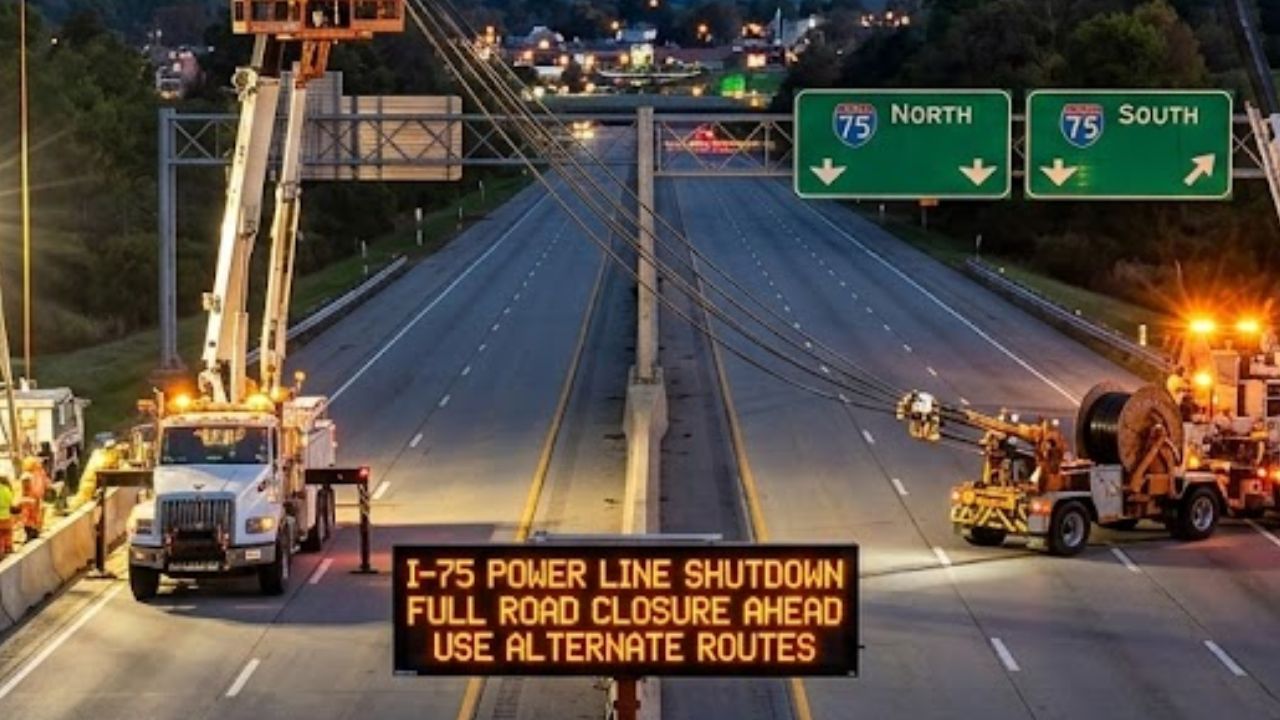
If you’ve ever been stuck on a highway with no clear explanation for why everything just stopped ,you know how helpless that feeling gets. The I-75 power line shutdown hit thousands of drivers exactly that way in early 2026. One moment the corridor was humming along. The next, downed lines, flashing emergency lights, and gridlock stretched for miles. Nobody was fully ready for it.
This article breaks down everything you need to know about the I-75 power line shutdown ,from what triggered it, how traffic and public safety were managed, to how utility companies scrambled to restore order. Whether you’re a daily commuter, a business owner along the corridor, or simply someone trying to understand how infrastructure failures cascade into real-life chaos, you’re in exactly the right place. Keep reading.
What Happened During the I-75 Power Line Shutdown?
Few infrastructure events in recent memory rattled daily life quite the way the I-75 power line shutdown did. It didn’t arrive with much warning. High-voltage transmission lines running parallel to critical sections of Interstate 75 experienced a sudden, cascading equipment failure in early 2026. The failure wasn’t isolated ,it compounded rapidly due to a combination of aging infrastructure, extreme weather stress, and gaps in real-time monitoring systems that should have caught the fault earlier.
The stretch of I-75 affected crosses multiple counties and serves tens of thousands of commuters, freight drivers, and travelers every day. When the lines went down, they didn’t just cut power ,they physically created danger zones on and near the highway. Downed power lines along roadside corridors forced immediate closures, and the electrical grid disruption rippled outward into nearby towns, signal systems, and emergency networks. What started as a utility fault quickly became a full-scale public safety event, and officials had to respond fast.
- High-voltage line failure occurred along multiple I-75 corridor segments
- Aging infrastructure accelerated the severity of the equipment breakdown
- Weather stress from recent storms weakened already-deteriorating components
- Real-time monitoring gaps delayed the initial fault detection by critical minutes
- Multiple counties experienced simultaneous grid outages due to line interdependency
| Factor | Role in Shutdown | Severity Level |
| Equipment Failure | Primary cause of line collapse | High |
| Aging Infrastructure | Amplified the damage spread | High |
| Severe Weather | Weakened structural integrity | Medium |
| Monitoring Gaps | Delayed detection and response | Medium |
| Grid Interdependency | Widened the affected zone | High |
Impact on Traffic and Public Safety
When the I-75 power line shutdown triggered road closures, traffic didn’t just slow ,it completely seized. Commuters who rely on I-75 as a daily artery faced a sudden, unannounced wall of standstill. Local authorities activated highway detours almost immediately, but the sheer volume of vehicles that use this corridor on any given morning made rerouting a logistical nightmare. Side roads absorbed overflow they were never built to handle.
Traffic disruption wasn’t the only problem. Downed power lines lying near or on roadways created invisible electrocution hazards for drivers who didn’t understand the danger of stepping outside their vehicles. Emergency response teams ,including fire departments, law enforcement, and hazmat units ,had to rapidly establish perimeters while simultaneously trying to manage traffic flow. Every minute of delay in clearing those hazard zones extended the risk window for hundreds of people still approaching the scene.
- Road closures stretched across major I-75 interchanges for several hours
- Highway detours pushed traffic through residential streets not rated for heavy volume
- Commuter delays of three to five hours were reported at peak congestion points
- Emergency response vehicles faced route obstruction, affecting incident response times
- Downed power lines created electrocution risk zones that required immediate public warning
| Traffic Impact | Description | Time Affected |
| Highway closures | Multiple I-75 entry/exit points sealed | 4–6 hours |
| Detour congestion | Residential route overload | 3–5 hours |
| Emergency access | Delayed response routes | 1–2 hours |
| Signal system failure | Intersections without power | Up to 8 hours |
| Commuter delays | Average 3–5 hour excess travel time | Full business day |
What Are the Most Common Causes of Highway Power Line Failures?
This is a question more people should be asking ,not just after an event like the I-75 power line shutdown, but well before one happens in their region. Understanding the root causes helps communities, regulators, and utility planners build better defenses. Most highway power line failures don’t come from a single dramatic event. They’re usually the result of compounding vulnerabilities that have been building for years.
Equipment failure sits at the top of the list. Transformers, insulators, and transmission towers all have finite lifespans. When maintenance schedules slip ,often due to budget constraints ,components degrade past safe operating thresholds. Severe weather, including ice storms, high winds, and flooding, pushes already-stressed components over the edge. And when monitoring systems aren’t modern enough to catch early fault signals, small problems escalate into corridor-wide shutdowns before anyone can intervene.
- Corrosion and metal fatigue in aging transmission towers weaken structural integrity over decades
- Ice accumulation on power lines during winter storms causes snapping under combined weight
- High wind events create line sway that leads to phase-to-phase contact and arcing
- Vegetation overgrowth near transmission corridors causes line contact and ground faults
- Transformer overload during peak demand seasons accelerates internal component failure
Utility Response and Agencies Involved
The moment the I-75 power line shutdown was confirmed, utility response teams mobilized. Speed mattered ,not just for restoring power but for managing live electrical hazards near a populated highway. Crews were deployed in coordinated waves: initial assessment teams first, followed by repair and restoration crews, and finally inspection units to certify safe re-energization of the lines.
What made this response complex was the sheer number of agencies that had to work in parallel. Utility companies can’t simply walk onto a highway and start repairs without traffic control in place. Local law enforcement had to establish and maintain safety perimeters. Emergency management coordinators handled logistics between agencies. Regulatory bodies required real-time updates and compliance documentation even as the crisis unfolded. The multi-agency nature of the response was both a strength and a source of friction ,coordination takes time, and time was something everyone was short on.
- Utility crews deployed in three waves: assessment, repair, and final certification
- Emergency management teams coordinated inter-agency logistics and public communication
- Law enforcement secured perimeters around downed line zones and directed traffic
- Regulatory bodies monitored repair compliance and required progress reporting every two hours
- Smart grid diagnostics helped crews pinpoint the fault origin without manual corridor walks
| Agency | Primary Role | Response Phase |
| Utility Crews | Line repair and restoration | All phases |
| Emergency Management | Coordination and logistics | All phases |
| Law Enforcement | Perimeter security, traffic control | Immediate through restoration |
| Regulatory Bodies | Compliance oversight | Active through post-event |
| Fire Departments | Hazard containment, public safety | Immediate response |
Ripple Effect on Local Economies
People often underestimate how far the damage travels when a highway corridor goes dark. The I-75 power line shutdown didn’t just affect drivers ,it hit local businesses, distributors, and tourism-dependent communities with a financial punch that lingered well after the power came back on. Gas stations, restaurants, and retail outlets along the I-75 corridor depend heavily on through-traffic. When that traffic vanishes for a day or more, revenue simply doesn’t recover.
Supply chain delays hit harder than most people anticipated. Freight carriers use I-75 as a primary distribution artery for the region. When road closures and highway detours added hours to standard delivery routes, perishable goods shipments missed delivery windows. Warehouses absorbed overflow inventory while retailers faced empty shelves. For small businesses operating on thin margins, even a 48-hour disruption can mean the difference between a profitable month and a difficult one.
- Retail foot traffic dropped sharply as consumers avoided the congested corridor entirely
- Restaurant and hospitality revenue fell by an estimated 30–50% during peak closure hours
- Freight carriers incurred extra fuel and labor costs from extended detour routes
- Perishable goods shipments faced spoilage risk due to multi-hour delivery delays
- Tourism businesses lost bookings as travelers rerouted away from the affected zone
| Economic Sector | Impact Type | Estimated Duration |
| Local retail | Foot traffic decline | 24–48 hours |
| Food & beverage | Revenue loss | 1–2 days |
| Freight & logistics | Delivery delays, added costs | 2–3 days |
| Tourism | Visitor diversion | Up to 1 week |
| Utilities | Emergency repair expenditures | Ongoing |
How Does a Power Line Shutdown Affect Emergency Services on Highways?
This is one of the most critical ,and least publicly discussed ,aspects of the I-75 power line shutdown. When power infrastructure collapses along a major highway corridor, emergency services don’t just face one challenge. They face a cascade of simultaneous complications that strain their resources and test their coordination systems to the limit.
First, downed power lines create active electrocution hazards that emergency responders must treat with extreme caution. Fire departments can’t simply drive through a zone with live wires on the ground. Every approach has to be carefully evaluated. Second, traffic backups created by road closures and highway detours physically block ambulances and fire trucks from reaching incidents beyond the shutdown zone. Response times increase ,and in medical emergencies, every minute counts.
- Ambulance response times increase significantly when primary highway routes are blocked
- Fire departments must stage equipment carefully to avoid live electrical hazard zones
- Police coordination across multiple jurisdictions becomes strained during extended shutdowns
- Communication networks may experience interference if power line infrastructure shares signal infrastructure
- Hospital systems in nearby communities may activate surge protocols if transport delays increase patient volume
Importance of Clear Public Communication
Good information during a crisis is as important as any physical response. The I-75 power line shutdown tested communication systems at every level ,and the results were mixed. Where agencies pushed timely, accurate updates through emergency alerts and social media, public compliance with safety instructions was higher and panic was lower. Where communication lagged, rumors filled the void and drivers made dangerous decisions.
Community preparedness depends on people receiving clear, actionable information before they need it ,not after they’re already stuck in a hazard zone. During this event, authorities who pre-positioned messaging on alternate routes, power line safety measures, and expected restoration timelines helped commuters make smarter choices. Those who waited too long to communicate left people guessing, which always makes a bad situation worse.
- Emergency alert systems pushed real-time closure and hazard notifications to mobile devices
- Social media updates from official accounts provided alternate route guidance every 30 minutes
- Local news coordination expanded the reach of safety messaging to non-digital audiences
- Highway digital signage that remained powered displayed updated detour directions continuously
- Community liaisons worked with neighborhood organizations to distribute information door-to-door in affected zones
Why Is I-75 So Vulnerable to Power Line Disruptions?
The honest answer involves history, geography, and budget ,none of which make for comfortable reading. The I-75 power line shutdown didn’t happen in a vacuum. I-75 runs through a long stretch of terrain that includes industrial zones, rural corridors, and densely populated urban areas. The electrical grid infrastructure running parallel to and crossing over this highway was largely built during a period of rapid postwar expansion. Much of it hasn’t been replaced since.
Aging infrastructure along I-75 has been flagged in state and federal infrastructure assessments for years. The combination of older transmission towers, outdated insulator technology, and limited smart grid integration means the corridor is significantly more vulnerable than modern standards would allow. Add to that the fact that extreme weather events are becoming more frequent and intense, and you have a corridor that faces increasing stress on a foundation that was built for a different era.
- I-75 spans multiple climate zones, exposing infrastructure to varied weather stress year-round
- Much of the corridor’s transmission infrastructure dates back to the 1960s and 1970s
- Smart grid technology upgrades have been slower along rural I-75 segments than in urban zones
- Maintenance budget constraints have deferred critical tower inspection and replacement work
- The corridor’s industrial and freight traffic load has grown far beyond original design capacity
| Vulnerability Factor | Current Status | Risk Level |
| Infrastructure Age | 40–60+ years old in key segments | High |
| Smart Grid Coverage | Incomplete along rural stretches | Medium-High |
| Weather Exposure | Multiple climate zones crossed | High |
| Maintenance Frequency | Below recommended standards | High |
| Traffic Load Growth | Exceeds original design specs | Medium |
What Steps Can Drivers Take When a Power Line Shutdown Occurs?
Most drivers have no training for this scenario. The I-75 power line shutdown put thousands of people in a situation they weren’t prepared for ,and many made choices that put themselves and others at greater risk. Knowing what to do before it happens is genuinely life-saving information.
The most important rule: if you see downed power lines near your vehicle, do not exit. Treat every downed line as live. Your vehicle’s rubber tires provide insulation ,stepping outside breaks that protection. If your car has actually contacted a power line, stay inside, call emergency services, and wait for trained responders to tell you it’s safe to move. If you must exit because of fire, jump clear of the vehicle without touching it and the ground simultaneously, then shuffle away with both feet together.
- Never exit your vehicle if downed power lines are anywhere near your car
- Call 911 immediately and provide your exact location using GPS or visible landmarks
- Avoid using alternate routes through residential zones unless directed by official signage
- Keep emergency supplies in your vehicle ,water, phone charger, and a basic first aid kit
- Monitor official channels like state DOT apps and emergency alert systems for real-time updates
- Turn around before entering a closure zone if you see flashing lights ahead and traffic reversing
Infrastructure Resilience: Lessons the I-75 Shutdown Taught Us
Every major infrastructure failure carries a lesson. The I-75 power line shutdown delivered several, and some of them were uncomfortable for regulators and utility companies to absorb publicly. The most obvious lesson: deferred maintenance is not a cost-saving strategy. It’s a debt that eventually comes due ,and it comes due during the worst possible conditions.
Infrastructure resilience means building systems that can absorb stress without total failure. That requires investment in smart grid technologies that detect faults early, redundant transmission pathways that allow rerouting when one line fails, and proactive inspection schedules that don’t get sacrificed to budget cycles. The I-75 corridor’s vulnerabilities were known. The shutdown was, in many ways, predictable ,which makes it more frustrating than a pure act of nature would be.
- Predictive maintenance programs using sensor data can catch equipment failure before it occurs
- Redundant transmission pathways allow rerouting power when primary lines go down
- Underground cabling in high-risk surface segments eliminates weather-related line failure risks
- Multi-agency training exercises before crises occur significantly improve coordinated response times
- Public education campaigns about power line safety reduce civilian risk during actual outages
FAQs
What caused the I-75 power line shutdown?
The I-75 power line shutdown resulted from high-voltage equipment failure worsened by aging infrastructure and severe weather exposure. Gaps in real-time monitoring delayed detection and allowed the fault to spread across multiple corridor segments.
How did the I-75 power line shutdown affect daily commuters?
The I-75 power line shutdown forced highway closures and rerouting that added three to five hours to typical commute times. Emergency detours overwhelmed residential roads and created additional accident risks throughout the region.
How should drivers prepare for an I-75 power line shutdown in the future?
Drivers should keep emergency supplies in their vehicles and monitor state DOT alert apps regularly. During an I-75 power line shutdown, following official detour signage and never approaching downed lines is essential for personal safety.
Which agencies respond to an I-75 power line shutdown?
Utility crews, emergency management coordinators, local law enforcement, fire departments, and regulatory bodies all respond to an I-75 power line shutdown. Multi-agency coordination is essential to manage safety, repairs, and traffic simultaneously.
What economic damage does an I-75 power line shutdown cause?
An I-75 power line shutdown disrupts retail foot traffic, delays freight deliveries, reduces tourism revenue, and creates financial strain for small businesses along the corridor. Economic recovery often takes longer than physical infrastructure restoration.
Are there alternate routes available during an I-75 power line shutdown?
Yes. During an I-75 power line shutdown, state transportation authorities designate official highway detours through alternate corridors. Drivers should follow digital highway signage and emergency alert updates rather than relying on standard navigation apps alone.
How long does it take to restore power after an I-75 power line shutdown?
Restoration timelines after an I-75 power line shutdown vary based on damage severity. Minor faults may be resolved in hours, while major equipment failure involving aging transmission infrastructure can extend outages to 24–72 hours or longer.
Conclusion
The I-75 power line shutdown was a stark reminder that infrastructure failure doesn’t stay contained. It spreads ,through traffic systems, emergency services, local economies, and community confidence. Every aspect of the response, from utility crews repairing downed lines to agencies coordinating public communication, revealed both strengths and gaps that demand serious attention going forward.
The central takeaway from the I-75 power line shutdown is that resilience requires investment before the crisis hits, not just reaction after it does. Upgrading aging infrastructure, expanding smart grid coverage, and running coordinated emergency preparedness drills are not optional extras. They’re the foundation of a highway corridor that communities can actually count on.
The next I-75 power line shutdown doesn’t have to be as damaging or as long. That choice belongs to the planners, the budget committees, and the regulators who hold the authority to act. Push for that action ,because the cost of inaction is always paid by the people on the road.