
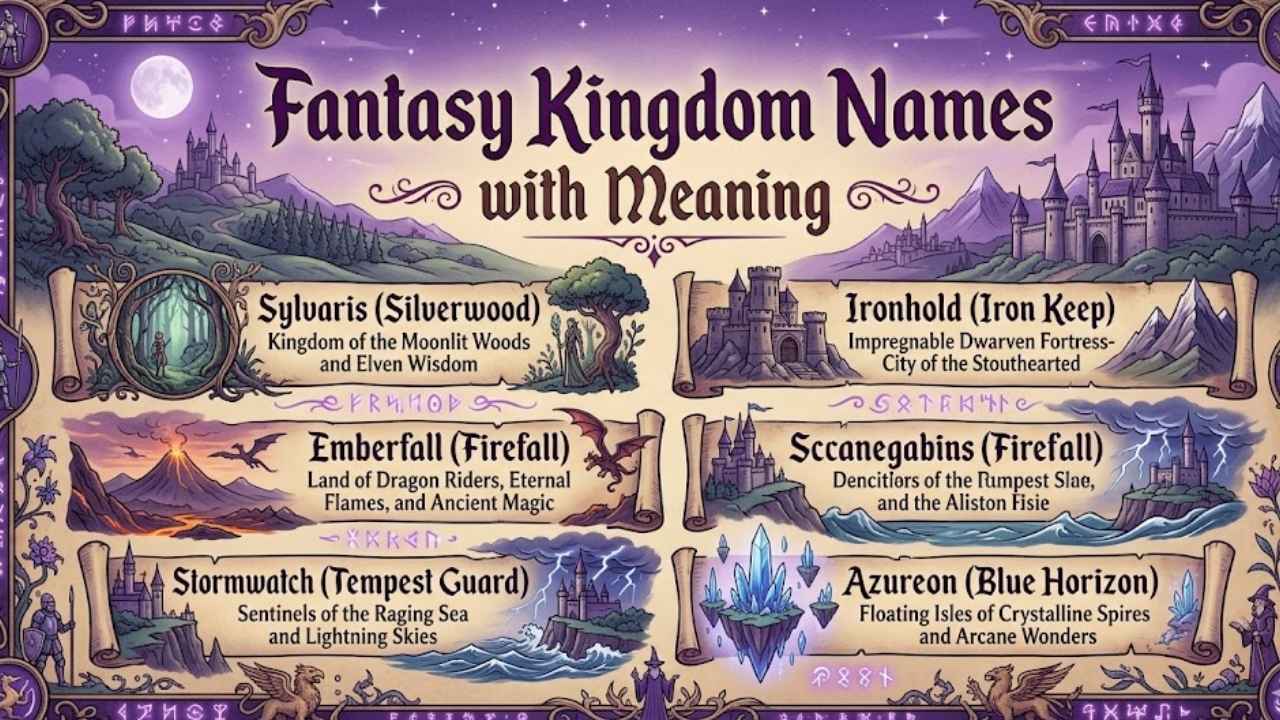
Have you ever spent hours trying to name a kingdom in your story, game, or D&D campaign only to end up with something that sounds flat and forgettable? That frustration is real, and every world-builder has felt it. The name of your kingdom sets the entire emotional stage before a single word of your story is written. Fantasy kingdom names with meaning aren’t just labels they’re the heartbeat of your world. A powerful name whispers history, culture, and magic all at once.
This guide gives you everything you need. Whether you’re writing a novel, building a fantasy map, running a tabletop campaign, or creating a game world, these fantasy kingdom names with meaning will spark ideas you didn’t know you had. You’ll find names across every theme dark, regal, mystical, mythological, war-torn, and more. Each one comes with a meaning so your world feels grounded and alive. Keep reading your perfect kingdom name is closer than you think.
Importance of Choosing the Right Kingdom Name
Picking the right name for your kingdom isn’t just a creative choice it’s a foundational decision that shapes your entire world. A great fantasy kingdom name with meaning tells readers what to expect before they even read the lore. It sets tone, signals culture, and creates emotional resonance instantly.
Strong kingdom names reflect geography, history, and the values of the people who live there. A name like “Verdantia” already conjures green meadows and peaceful abundance. A name like “Dreadmoor” immediately warns you to stay away.
| Element | Why It Matters | Example |
| Tone | Sets emotional expectations | Nocthaven = dark, mysterious |
| Culture | Reflects the people’s heritage | Celtara = Celtic roots |
| Geography | Grounds the kingdom in place | Riveron = water-based realm |
| History | Adds depth and backstory | Romarion = echoes of empire |
| Magic Level | Signals the world’s power system | Arcania = arcane energy |
- Bold, meaningful names pull readers into your world instantly without needing extra explanation.
- Avoid clichés like “Darkland” or “Magicville” they sound lazy and kill immersion fast.
- Pronounceable names matter. If your reader can’t say it, they won’t remember it.
- Names tied to lore feel authentic. Tie each name to a founding story or historical event.
- Genre alignment is critical. A sci-fi kingdom name sounds wrong in a medieval fantasy and vice versa.
Think of your kingdom name as a promise to your audience. It’s the first piece of lore they receive. Make it count.
Best Kingdom Names To Blow Your Mind
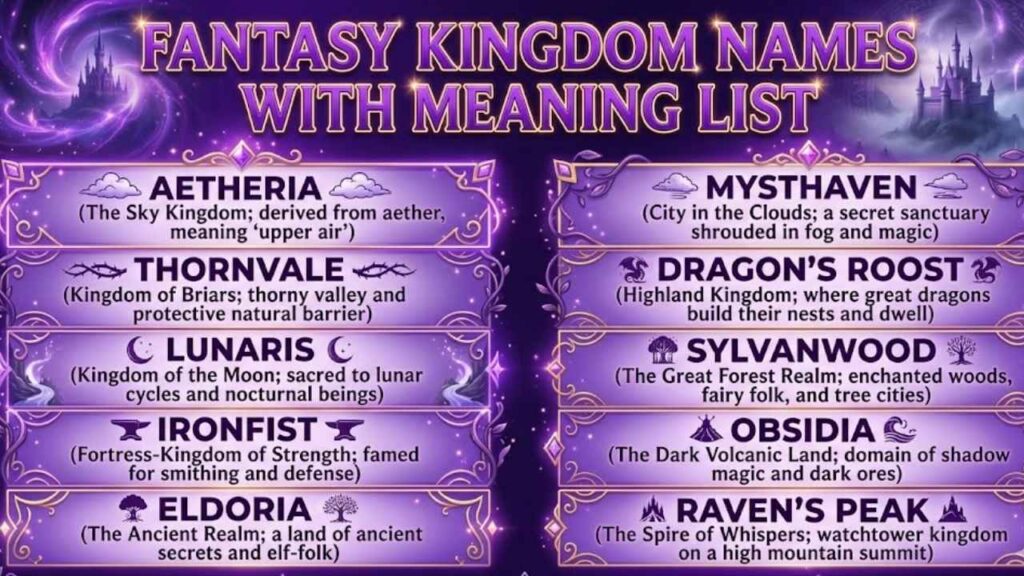
These are the standout kingdom name ideas that blend raw power with deep meaning. They rise above the rest because they work across multiple genres while still feeling distinctly original. Each of these fantasy kingdom names with meaning carries an emotional charge strong enough to anchor an entire world.
- Creative kingdom names should feel both invented and believable at the same time.
- Lore-rich names give writers a natural launching point for backstory and culture.
- Epic world creation starts with a single name that feels undeniably right.
- Game kingdom names need to be short enough to say quickly but deep enough to feel real.
- Fantasy storytelling thrives when the setting itself has a distinct emotional identity.
| Kingdom Name | Meaning | Best Used For |
| Avalonara | Eternal haven of mist | Arthurian-style fantasy |
| Shadowforge | Forged in endless darkness | Dark fantasy, villain empires |
| Lumindor | Light of ancient stars | High fantasy, celestial kingdoms |
| Crownspire | Tower of royal glory | Regal empires, noble houses |
| Dragonhold | Fortress against fiery beasts | Dragon realms, epic adventures |
- Avalonara: Rooted in Arthurian legend, this name evokes mist-wrapped islands and eternal peace.
- Shadowforge: Cold, industrial, and ominous perfect for a kingdom built through suffering and fire.
- Lumindor: Soft and luminous, suggesting a civilization guided by starlight and ancient wisdom.
- Crownspire: Commands authority immediately, ideal for a seat of noble power and royal legacy.
- Verdantia: Green and alive, this name breathes ecological abundance and natural harmony.
- Nocthaven: A sanctuary cloaked in night, ideal for nocturnal cultures or shadow-dwelling races.
- Arcania: Pure arcane energy condensed into a name a sorcerer’s paradise waiting to be explored.
- Zephyrion: Wind-touched and free, suggesting open plains governed by air-born spirits or nomads.
- Valhallor: Warrior glory echoes from every syllable built for battle-hardened, honor-bound kingdoms.
- Emperion: Grand, enduring, and imperial a name that makes every other kingdom feel smaller.
- Aetherlyn: Delicate yet cosmic, pointing to a kingdom floating between worlds or atop cloud peaks.
- Questoria: A realm built around purpose its citizens live to seek, explore, and achieve great things.
- Veilshadow: Something hidden waits inside these borders, a kingdom of secrets and shifting truths.
- Enchantia: Magic doesn’t just exist here it breathes, grows, and rules every corner of this land.
- Olympira: Touched by divine energy, this name suits kingdoms where gods once walked the earth.
- Romarion: Imperial echoes from a golden age of conquest and architecture inspire this powerful name.
- Scarforge: Battle-scarred and proud, a kingdom that survived impossible odds and wears its wounds.
- Neonara: Futuristic and glowing, where magic and technology blur into something entirely new.
- Battlerealm: No pretense here this kingdom was born in war and exists to fight and endure.
- Duskmourn: Melancholy and haunting, a kingdom still grieving a great loss buried in its history.
- Ethervane: A windswept realm high above the clouds where time moves at its own strange pace.
- Ironcrest: Stubborn, proud, and immovable a mountain kingdom that has never bent to invaders.
- Solgrave: Where the sun was buried a desert kingdom built atop an ancient celestial ruin.
- Tempestria: Storms are sacred here, and the rulers draw power from thunder and lightning itself.
- Aurorheim: Named for the northern lights, a kingdom of brilliant colors, ice, and quiet magic.
Ethereal & Mystical Kingdom Names
Mystical kingdom names carry a dreamlike quality that separates them from every other category. These fantasy kingdom names with meaning use soft syllables and celestial imagery to build worlds that feel genuinely otherworldly. They suit enchanted forests, floating isles, and celestial kingdoms where the boundaries between the physical and spiritual dissolve completely.
- Ethereal fantasy kingdom names work beautifully for elven civilizations or angel-governed realms.
- High fantasy world names in this category often borrow from astronomical or elemental vocabulary.
- Celestial kingdoms feel most authentic when the name itself sounds like it could belong to a star.
- RPG world creation benefits enormously from names that players immediately associate with wonder.
- Mystical realms should carry names that feel ancient and slightly out of reach familiar but foreign.
| Name | Meaning | Emotional Tone |
| Lumindor | Light of the stars | Hopeful, radiant |
| Aetherlyn | Realm of pure essence | Delicate, cosmic |
| Celestara | Heavenly star domain | Divine, elevated |
| Mistveil | Veiled in misty dreams | Mysterious, soft |
| Lunarion | Moon’s gentle embrace | Calm, romantic |
- Lumindor: Ancient starlight guides every path here a civilization built entirely around celestial wisdom.
- Aetherlyn: Pure and weightless, this realm exists at the intersection of air, spirit, and possibility.
- Celestara: Every building here was designed to mirror the constellations beauty as devotion to the sky.
- Mistveil: You can never be entirely sure what’s real in Mistveil, and that’s precisely the point.
- Elyndor: Timeless light wraps every stone here, and the citizens believe darkness cannot truly enter.
- Seraphim: Built by beings of divine light, this kingdom exists as proof that angels once ruled the earth.
- Auroria: The sky bleeds gold every morning here, and residents believe dawn itself was born from this land.
- Nebulon: A kingdom built inside a cosmic cloud, where the weather is made of stardust and silence.
- Sylvandar: Silver winds carry messages between the towers here, and music is the kingdom’s true language.
- Harmonia: Every law, every tradition, every building in this kingdom was designed around perfect balance.
- Lunarion: Tides govern everything from farming cycles to royal succession in this moon-touched land.
- Zephyria: Breezes carry seeds, stories, and spells alike across these wide, open, sacred skies.
- Crystalyn: Pure crystalline structures grow naturally from the earth here, used as both tools and temples.
- Dreamforge: Every great invention, law, and art piece in this kingdom began as someone’s sleeping vision.
- Ethereon: A kingdom that exists slightly outside physical reality, accessible only through meditation.
- Faeriel: Fairy light never fades here the glow is woven into every stone and living creature.
- Galaxia: Citizens here map new constellations as their primary form of science and spiritual practice.
- Havenstar: Built beneath the brightest star in the sky, this kingdom was founded on the promise of safety.
- Illumina: Light is the kingdom’s currency, its religion, and its most powerful form of defense and healing.
- Quintara: Scholars here believe they’ve discovered a fifth element, and the kingdom is built upon its study.
- Phaedra: A blazing, ethereal glow defines the atmosphere here warm but never quite explainable.
- Orionis: Named for the great hunter of stars, citizens here believe they are destined to claim the sky.
- Mystara: Mysteries deepen the closer you travel to the center of this kingdom answers always retreat.
- Radiantor: Divine radiance pours from the throne room itself, and every ruler must prove they can bear it.
- Thaloria: Waves of ethereal energy roll through this coastal kingdom like tides made of pure consciousness.
Dark & Mysterious Kingdom Names
Dark kingdom names carry weight that lighter categories simply can’t match. These fantasy kingdom names with meaning use harsh consonants, shadow imagery, and ominous concepts to build tension before a single story beat occurs. They’re perfect for dark fantasy settings, villain empires, and DND kingdom names where moral ambiguity thrives in every alley and throne room.
- Mysterious fantasy kingdom names work best when they hint at something buried and never fully explained.
- Dark fantasy settings need names that feel dangerous even when spoken aloud in daylight.
- Fictional empire names in this category gain power from the use of Latin, Old English, or invented roots.
- Mythical creature kingdoms benefit from names that suggest beasts rule or once ruled this land.
- Shadow-based names create immediate visual associations that set your world’s atmosphere without effort.
| Dark Kingdom Name | Core Meaning | Suggested Ruler Type |
| Nocthaven | Sanctuary of night | Shadow sorceress |
| Veilshadow | Hidden behind black veils | Spy master / assassin king |
| Dreadmoor | Where fear grows wild | Fear-wielding warlord |
| Eboncrypt | Built over forgotten tombs | Necromancer emperor |
| Wraithhold | Haunted by silent ghosts | Undead sovereign |
- Nocthaven: Every citizen here was born at midnight, and the culture celebrates darkness as sacred protection.
- Veilshadow: Nothing in this kingdom is what it appears diplomacy here is just deception dressed in silk.
- Dreadmoor: The moors themselves are alive with fear, and newcomers rarely last more than three nights.
- Eboncrypt: Built directly atop the largest graveyard in the known world, death is their founding resource.
- Gloomspire: The towers here absorb light, leaving the streets in perpetual twilight regardless of the hour.
- Ravenacht: Ravens are considered divine messengers here, and killing one is punishable by exile or death.
- Umbravale: The valley runs so deep that sunlight hasn’t touched the floor in recorded history.
- Obsidianreach: Everything from the palace walls to the soldiers’ armor is carved from pure volcanic glass.
- Wraithhold: Ghosts don’t haunt this fortress they serve it, acting as guards that no blade can wound.
- Nyxthorn: A wall of enchanted thorns surrounds the capital, grown from the bones of fallen invaders.
- Shadegrave: Graves here breathe in winter, and citizens believe their ancestors still vote in every election.
- Morvath: Whispers carry power in this ancient land, and the loudest voice is always the one you never hear.
- Cimmeria: A realm where twilight is permanent no full day, no true night, just endless in-between grey.
- Vordrak: Dragon shadows shaped the culture here citizens believe shadow itself is a living, breathing god.
- Silentveil: The punishment for speaking too loudly is three days in the veil, and no one returns unchanged.
- Abyssfell: This empire fell toward the void centuries ago and has been slowly descending ever since.
- Duskmourn: A kingdom still in collective grief over a sun that vanished from their sky three hundred years ago.
- Nightforge: The smiths here work only in darkness, claiming daylight weakens both metal and magic equally.
- Cryptmoor: The swamp hides thousands of crypts, and local guides are always paid well for good reason.
- Sablecrown: The crown itself is made of condensed shadow, and only those who fear nothing can wear it.
- Grimveil: Every generation here pulls a new veil over their past, erasing what hurts and preserving the darkness.
- Voidreach: At the kingdom’s edge, the land simply stops, and something enormous stares back from nothing.
- Phantasmor: Citizens here live alongside the nightmares they’ve survived, treating them as honored neighbors.
- Tenebris: Light is considered a foreign invader here windows are sealed, and fire is only used in ritual.
- Eclipseborn: This kingdom was founded on the exact hour of a total eclipse, and that dark hour still governs all.
Regal & Noble Kingdoms
Regal kingdom names and noble kingdom names are built for grandeur. These fantasy kingdom names with meaning use majestic prefixes and suffixes to project authority, honor, and centuries of tradition. They suit stories centered on political intrigue, royal dynasties, and the weight of inherited power in medieval kingdom concepts where every title carries history.
- Medieval kingdom concepts come alive when the name itself sounds like it was carved into a stone arch.
- Ancient world kingdoms inspire regal names that carry the dust of centuries and the shine of polish.
- Regal dynasty names should feel like they belong on a royal seal, a battle flag, and a family crest.
- Fantasy storytelling with noble themes benefits from names that command respect before a word is spoken.
- Naming kingdoms in the noble category works best when you anchor the name to a specific virtue or symbol.
| Kingdom | Meaning | Noble Theme |
| Crownspire | Spire of the crown | Royal succession |
| Emperion | Eternal noble empire | Imperial legacy |
| Valorion | Valor’s eternal domain | Military honor |
| Monarchia | Monarchy’s pure land | Governance and order |
| Dynastor | Dynasty’s strong hold | Ancestral bloodlines |
- Crownspire: The tallest tower in the known world stands here, visible from every corner of the kingdom.
- Emperion: Three hundred emperors have ruled this land, and every one of them added one new law.
- Thronedale: The valley itself was chosen because it cradles the throne room like a reverent pair of hands.
- Majestica: Citizens here are taught from birth that the kingdom’s name is a promise they must keep forever.
- Sovereignhold: Every citizen here holds one sovereign right that no ruler not even the king can revoke.
- Dynastor: Bloodline matters here above all else, and genealogy is both science and sacred scripture.
- Paladinor: The original founders were paladins, and their code of honor still governs every law written today.
- Regalia: The royal artifacts here are alive they choose the next ruler rather than waiting to be inherited.
- Aristara: Noble families here are ranked by the brightness of their ancestral star visible in the night sky.
- Lionheart: Courage isn’t just admired here it’s a legal requirement for anyone seeking civic leadership.
- Goldenreich: The economy runs entirely on gold harvested from the kingdom’s enchanted river system.
- Valorion: Valor is the kingdom’s religion, its military doctrine, and its most beloved form of entertainment.
- Eaglecrest: Eagles nest in the palace towers and are considered co-rulers, never caged and never ignored.
- Knightvale: Knights founded this valley kingdom, and every citizen still trains for at least three years.
- Lordspire: Each great family built one tower, and the skyline tells the complete political history of the realm.
- Monarchia: The monarchy here has never been broken four thousand years of unbroken royal succession.
- Noblesse: Nobility here isn’t inherited it’s earned through demonstrated service and sacrifice.
- Sceptara: The scepter governs more than the king here it casts the deciding vote in all tied council decisions.
- Titanreich: Founded by beings of titanic strength, citizens here still measure worth through physical endurance.
- Wardenor: Wardens guard not just borders but memories the kingdom’s living historians who never write anything down.
- Heraldicor: Every family crest here tells a true story, and falsifying one is the kingdom’s only capital offense.
- Peerage: Social rank is fluid here citizens can rise and fall based entirely on public acts of honor.
- Silvermark: Marked by silver since its founding, even the humblest cottage here has a silver threshold stone.
- Galanthor: Chivalry isn’t a tradition here it’s a living law enforced by both knights and common citizens alike.
- Aurelium: Gold runs through the very stone of this kingdom’s foundations, feeding its soil and its ambitions equally.
Exotic & Unique Kingdom Names
Exotic kingdom names and unique kingdom names pull from global cultures, unusual linguistics, and unexpected combinations to create kingdom name ideas that stand completely apart from standard fantasy naming. These creative kingdom names use unfamiliar sounds and cross-cultural blends to produce worlds that feel genuinely original and impossible to categorize.
- Culturally-inspired kingdoms draw authenticity from real linguistic structures without directly copying any culture.
- Fantasy naming inspiration from global sources produces names far richer than purely invented syllable stacking.
- Exotic kingdom names work best when they suggest a geographic and cultural origin the reader can almost place.
- Unique kingdom names should feel impossible to confuse with any other name in your world or outside it.
- Kingdom name ideas in this category thrive when you blend two or three language roots into one cohesive sound.
| Exotic Name | Cultural Inspiration | Meaning |
| Zephyrion | Greek (zephyros) | Wind-whispered lands |
| Tazara | Swahili-influenced | Desert jewel empire |
| Jinnara | Arabic (jinn) | Spirit-touched winds |
| Pyralis | Greek (pyr = fire) | Fire-hearted realm |
| Kismet | Turkish/Persian | Fate’s chosen path |
- Zephyrion: Wind governs politics here the direction of the seasonal breeze determines the harvest law.
- Quorvex: An enigma wrapped in stone and silence, this kingdom challenges every traveler’s sense of logic.
- Xanadu: Paradise isn’t just a promise here it’s a physical location that citizens defend with fierce devotion.
- Vortexia: Everything spirals inward here, from the architecture to the social structure to the ruling dynasty.
- Tazara: A jewel in the desert that trades in rare spices, silk, and secrets carried across a thousand miles.
- Saffronor: Golden-orange skies at sunset are considered divine, and the kingdom’s laws are written in saffron ink.
- Rivenmoor: Split down the middle by a great rift centuries ago, two cultures now share one fractured nation.
- Pyralis: Fire is worshipped, controlled, and weaponized here every citizen must pass a flame trial at sixteen.
- Nomadia: No fixed capital exists the government travels on the back of ten thousand camels year-round.
- Lotusvale: The lotus grows everywhere here, considered sacred, and no one may harm one under any law.
- Jinnara: Spirit-touched winds carry the voices of ancestors, and citizens consult them before major decisions.
- Indigora: Deep indigo dye made from sea creatures drives the entire economy and defines the cultural identity.
- Djinhold: Djinn aren’t myths here they’re citizens, property owners, and occasionally council members.
- Cinnabar: Red mineral defines the architecture, the medicine, the art, and the spiritual practice of this land.
- Bazaaria: Every political negotiation here happens in a marketplace, because commerce is considered holy.
- Azulor: Blue oceans surround this island kingdom, and every law was written to honor and protect the sea.
- Sirocco: Hot desert winds shaped this culture patience is the highest virtue because the wind always shifts.
- Yggdril: Tree roots run as deep as the buildings stand tall here, and the oldest root is considered the true ruler.
- Falconis: Falconry is the kingdom’s primary form of military intelligence, diplomacy, and spiritual practice.
- Haramoor: Forbidden moors surround the capital, and only the monarch’s chosen guides may navigate them safely.
- Garamond: Known for the finest scripts in the world, this kingdom built its empire on the power of written words.
- Eldritch: Strange magic that nobody fully understands powers everything from the streetlights to the monarchy.
- Utopix: Citizens genuinely believe they’ve built the perfect society visitors consistently disagree in private.
- Tigris: Twin rivers define the borders and the culture here one river gives life and one slowly takes it back.
- Vermilion: Everything from the soil to the rooftops carries a brilliant red hue that visitors find both stunning and unsettling.
Nature-Inspired Kingdom Names
Nature-inspired kingdom names connect your world to the living earth in ways that feel immediately authentic. These fantasy kingdom names with meaning use botanical, geological, and elemental vocabulary to build magical nature realms that breathe and grow. They’re ideal for forest kingdom ideas, coastal empires, and fantasy map names where the landscape shapes the culture as much as any ruler.
- Magical nature realms feel most believable when the kingdom’s name directly mirrors its environment.
- Forest kingdom ideas thrive on names with woody, green, or earthy syllables that evoke ancient growth.
- Fantasy geography benefits from nature-based names because they help readers visualize the landscape instantly.
- Enchanted forests deserve names that sound like they grew rather than were built by human hands.
- Worldbuilding ideas rooted in nature produce cultures with inherently rich ecological relationships and lore.
- Verdantia: Every law here was written to protect green life cutting a tree requires a council vote.
- Aquilon: Water governs everything from the calendar to the currency in this river-centered civilization.
- Floralia: Flowers bloom year-round here because the soil was enchanted by the kingdom’s first nature-mage.
- Groveheart: The heart of the kingdom is literally a grove the throne sits beneath the oldest tree in history.
- Riveron: Seventeen rivers meet at the capital, making it the world’s greatest natural crossroads and market.
- Oakspire: Ancient oaks taller than towers define the skyline, and the tallest one holds the royal library inside.
- Meadowreich: Rolling meadows stretch to every horizon, and the kingdom’s army fights on horseback exclusively.
- Leafmoor: The moors here change color with every season, and citizens read the colors as natural prophecies.
- Fernvale: Hidden valleys of fern hide the kingdom from aerial view it’s been undiscovered by three empires.
- Earthor: Citizens here believe the earth itself is sentient, and they ask its permission before building anything.
- Dewdrop: Morning dew is collected as sacred water the purest medicine and the most sincere diplomatic gift.
- Arboria: Every citizen plants a tree at birth, and their tree’s health is legally tied to their civic standing.
- Vinehold: Enormous ancient vines hold the stone walls together removing one could bring down the fortress.
- Stormwood: Trees here have been struck by lightning so many times that their wood conducts electricity naturally.
- Petalia: Soft-petaled flowers cover every surface including weapons, armor, and official documents as tradition.
- Mossreich: Moss carpets every stone surface in the capital, muffling sound and making the city eerily serene.
- Lakeveil: Mist rises from the central lake every dawn, and no one has ever mapped the lake floor completely.
- Gladeor: Open glades serve as courts, markets, and temples all official business happens outdoors only.
- Bloomvale: The valley blooms twice yearly with flowers that glow faintly at night and attract rare creatures.
- Wildroot: The root system beneath this kingdom is so complex that tunneling through it is a capital offense.
- Ivyspire: Ivy has completely covered every original building, and citizens let it grow as a form of honor.
- Herbmoor: Every herb with healing properties grows wild here, and the kingdom funds its army through medicine.
- Deltahold: Built where a great river splits into dozens of tributaries, creating a kingdom of natural canals.
- Bramble: Thorns protect the borders more effectively than any wall, and the guards cultivate them deliberately.
- Avalanche: Snow is both the kingdom’s greatest threat and its most powerful defensive weapon in mountain war.
What Are the Most Unique Fantasy Kingdom Names With Meaning?
The most unique fantasy kingdom names with meaning avoid obvious combinations and lean into unexpected linguistic territory. Names like Quintara, Vordrak, and Aetherlyn stand out because they blend unfamiliar sounds with grounded symbolic meaning. The best ones feel impossible to categorize yet instantly memorable.
Uniqueness in kingdom name ideas comes from three sources: invented syllable combinations, cross-cultural linguistic blending, and symbolic layering. A name that sounds invented but carries real etymological weight like “Tenebris” from Latin for darkness achieves both originality and depth simultaneously. That combination is what separates forgettable names from iconic ones.
Historical Kingdom Names
Historical kingdom names bring real-world depth to fictional worlds by drawing from actual empires, civilizations, and cultures. These fantasy kingdom names with meaning use linguistic echoes from Rome, Egypt, the Norse world, and beyond to create fictional kingdoms that feel like they could have existed. They’re perfect for fantasy geography that mirrors Earth’s history through a magical lens.
- Ancient empires list provides a treasure trove of prefixes, suffixes, and naming conventions worth studying.
- Linguistic roots for kingdom naming from Latin, Norse, or Celtic create instant cultural associations.
- Historical kingdom names work best when they evoke a real civilization without directly copying it.
- Mapmaking for fantasy worlds becomes richer when historical naming traditions inform regional differences.
- Fictional kingdoms built on historical foundations feel earned rather than invented, which builds reader trust.
| Historical Influence | Kingdom Name | Era Evoked |
| Roman Empire | Romarion | Imperial conquest |
| Norse mythology | Vikingor | Viking Age exploration |
| Ancient Egypt | Egyptara | Pharaonic civilization |
| Byzantine Empire | Byzantor | Golden age of Christianity |
| Greek civilization | Hellenic | Classical philosophy |
- Romarion: The architecture here mirrors ancient Rome so closely that historians argue it was built by time travelers.
- Celtara: Oral tradition governs law here nothing is written, and memory is the most honored civic skill.
- Byzantor: Gold mosaic covers every surface in the palace, and the emperor governs through divine appointment.
- Egyptara: The kingdom was built along one great river, and every monument faces the rising sun deliberately.
- Vikingor: Longships still govern trade here, and the king must personally lead the first voyage of every spring.
- Spartara: Children here train from age seven, and the kingdom’s military record is considered its greatest art form.
- Incahold: Terrace farming covers every mountain face, and the engineering still baffles visiting scholars today.
- Persiora: Silk, poetry, and mathematics are this kingdom’s greatest exports and most celebrated achievements.
- Hellenic: Philosophy is a civic duty here every citizen must debate publicly at least once every three years.
- Feudalia: Strict feudal hierarchies govern everything, and social mobility technically exists but practically doesn’t.
- Crusador: Holy wars are still being planned in the council chambers, and every citizen is considered a soldier.
- Aztecor: The sun demands tribute here, and the annual ceremony is the kingdom’s largest civic and religious event.
- Mongolor: Horseback is the only acceptable form of royal travel, and the grasslands stretch beyond any map’s edge.
- Ottoman: The grand bazaar is the actual seat of power here whoever controls trade controls the throne.
- Samurai: Honor codes written eight centuries ago still govern every duel, marriage, and trade deal made today.
- Norsevale: Ice and ambition share equal billing here the cold is considered a test the worthy are meant to pass.
- Celticmoor: Druids hold more political power than the king, and the moors are considered the kingdom’s true capital.
- Latinor: Every official document here is written in an archaic root language that most citizens can’t fully read.
- Renaissance: Art and science are the same discipline here, and the greatest painters are also the greatest engineers.
- Victorian: Industrial innovation drives this kingdom, but strict social codes keep the ruling class firmly in power.
- Pharaoh: The ruler here is considered literally divine death doesn’t remove them from power, it elevates them.
- Empireold: Citizens here carry maps of their empire from eight hundred years ago and mourn every lost territory.
- Greekspire: Philosophy towers physically over the skyline, with temples to logic built taller than temples to gods.
- Romanveil: Secrets govern this kingdom the senate meets in private and the public votes on what they’re told.
- Spartanhold: The walls are deliberately plain because the citizens believe beauty weakens the national spirit.
Epic Fantasy Kingdom Name Ideas
Epic fantasy kingdom name ideas exist in the space where legends are born. These fantasy kingdom names with meaning use bold, sweeping vocabulary to suggest worlds where great battles, ancient prophecies, and legendary heroes define the landscape. They’re ideal for dragon realms, quest-driven narratives, and DND kingdom names where the stakes never drop below civilization-shaking.
- Fantasy prefixes and suffixes like “hold,” “realm,” and “or” add natural weight to epic naming choices.
- Realm name ideas in this category should feel like they belong on the banner of a legendary army.
- Epic world creation demands names that make a reader feel the stakes before the first chapter ends.
- Dragon realms carry the most impact when the kingdom name itself suggests fire, scale, or ancient power.
- Fantasy storytelling at the epic scale works best when every location name could double as a battle cry.
- Dragonhold: The original fortress was built inside a dormant dragon the bones still form the outer walls.
- Questoria: Every citizen here is born with a purpose assigned by the kingdom’s oracle at the moment of naming.
- Heroon: Heroes don’t retire here they ascend to become the kingdom’s founding myths in their own lifetime.
- Sagaor: Every generation adds one chapter to the kingdom’s living saga, written on the walls of the great hall.
- Legendara: Legends aren’t history here they’re legal precedent, and courts cite them in every ruling.
- Battlemoor: The moors have been fought over so many times that the soil itself is considered consecrated ground.
- Fatehold: Citizens believe their fates are stored physically inside the fortress, and the king guards them personally.
- Gloryspire: The tallest point in the known world, built not for defense but purely as proof of what this kingdom achieved.
- Mythhold: Myths are stored here like artifacts catalogued, protected, and occasionally weaponized in war.
- Runehold: Ancient runes carved into the fortress walls are still actively casting spells, though no one remembers writing them.
- Loremoor: The moors are covered in inscribed stones left by travelers across centuries, forming a living library.
- Herospire: The spire changes color to honor each new hero recognized by the council it’s currently seventeen colors.
- Prophecy: Every ruler here was named in a prophecy before their birth, and the process of finding them is a kingdom-wide event.
- Ballador: Ballads carry more legal weight than written law here bards are the most powerful civic figures alive.
- Epos: Epic poems replace census records here a family’s worth is measured by the length of their ancestral poem.
- Chronicles: The kingdom keeps a living chronicle updated daily by a team of two thousand dedicated scribes and witnesses.
- Sorceror: The ruler must be a sorcerer not symbolically but literally, tested publicly in the great arena every decade.
- Destiny: Citizens here believe they are chosen, and every hardship is reframed as part of a divine larger plan.
- Dragonmoor: Dragons once controlled this land, and the current rulers still pay a symbolic tribute to their memory.
- Warriorvale: The valley was carved by the footsteps of a hundred thousand warriors over five great wars and three civil ones.
- Lanceor: The ceremonial lance that founded this kingdom is still displayed, and touching it grants legal sanctuary.
- Epicvale: The valley’s acoustics make every speech echo for miles, and rulers have used this deliberately for centuries.
- Questreich: Citizens here are taxed not in gold but in completed quests the kingdom runs on adventurous ambition.
- Gloryhold: The treasury here holds not gold but documented acts of glory, considered more valuable than any currency.
- Battleor: War is considered sacred art here, and the greatest battles are reenacted annually as cultural theater.
Why Do World-Builders Prefer Fantasy Kingdom Names With Meaning Over Random Names?
Names with built-in meaning give world-builders a structural shortcut. When your fantasy kingdom names with meaning carry inherent symbolism, you don’t need pages of lore to establish identity the name does it instantly. A kingdom called “Wraithhold” already tells you its history, its culture, and its dangers without a single additional word.
Random names, by contrast, require enormous amounts of supporting text to feel real. Kingdom name ideas with genuine etymological or symbolic roots create an immediate emotional association that random syllable combinations simply can’t achieve. Readers and players form stronger attachments to places whose names feel earned rather than invented on the spot.
Futuristic & Sci-Fi Kingdom Names
Futuristic fantasy kingdom names with meaning push the genre into exciting hybrid territory where magic and technology coexist, compete, and sometimes merge completely. These fantasy kingdom names with meaning suit worlds where ancient spells power digital networks or where starships are guided by elemental mages instead of computers.
- Cosmic kingdoms blend celestial scale with technological ambition in ways that feel genuinely new.
- Fantasy realm generator concepts thrive in sci-fi fantasy hybrids because the rules are more flexible.
- Underwater kingdoms with technological themes become especially compelling when the name reflects both elements.
- Fictional empire names in this category should feel futuristic without abandoning the weight of fantasy tradition.
- High fantasy world names gain fresh energy when crossed with technological vocabulary used purposefully.
| Sci-Fi Kingdom | Tech Theme | Fantasy Element |
| Neonara | Light and energy | Magical illumination |
| Quantor | Quantum physics | Arcane probability magic |
| Stellaris | Star navigation | Celestial magic systems |
| Nexus | Network connection | Ley line intersections |
| Synthara | Synthetic creation | Artificial life-weaving |
- Neonara: Glowing circuits run through the stone walls here, powered by both electricity and ancient light spells.
- Quantor: Probability itself is manipulated here the kingdom’s greatest weapon is controlled uncertainty.
- Cyberhold: Every soldier here is augmented with both magical enchantments and mechanical enhancements simultaneously.
- Stellaris: Navigation by stars is both the kingdom’s science and its most sacred spiritual discipline.
- Hologor: Nothing here is entirely solid architecture shifts based on need, projected from central crystal nodes.
- Plasma: Energy itself is the currency here, and citizens are taxed based on how much power they personally generate.
- Galactica: The kingdom spans multiple star systems, governed by a council that meets only in shared dream-space.
- Hyperion: Speed is considered divine here the fastest citizen in any given year automatically joins the council.
- Matrix: Reality layers here like geological strata, and citizens move between layers as casually as changing rooms.
- Nexus: All ley lines in the world intersect at this kingdom’s capital, making it the most powerful spot on earth.
- Orbital: The kingdom floats in a stable orbit ground-dwellers believe it’s a myth because it’s never visible twice.
- Photon: Light travels differently here shadows have color, and darkness is considered a visible living substance.
- Quantumveil: The kingdom exists in superposition it can be observed or influential but never simultaneously both.
- Synthara: Life is created here through a combination of genetic weaving and arcane animation that nobody else has replicated.
- Ultrahold: The fortress here cannot be damaged by any known force the enchantment was written in a dead language.
- Vortex: Time moves in spirals here, and citizens experience the same day multiple times with minor variations.
- Xenon: The atmosphere here is slightly different citizens glow faintly and their lifespan doubles the regional average.
- Biosphere: The entire kingdom operates as one living organism harm one part and the whole system responds.
- Circuit: Magic here flows through visible channels in the ground like electrical circuits, mapped and maintained daily.
- Android: Constructed beings make up thirty percent of the population and hold full legal citizenship since the third era.
- Warpmoor: The moors can be traversed in seconds if you know the warp points if you don’t, you may never leave.
- Robotor: Mechanical creatures built centuries ago still govern much of the kingdom’s infrastructure autonomously.
- Droidvale: The valley was originally built by constructs, and the original blueprints are the kingdom’s constitution.
- Laseror: Focused light beams serve as both weapons and communication tools, controlled by specially trained mages.
- Fusion: Two civilizations merged here centuries ago one magical and one mechanical and neither fully dominated.
Magical & Enchanted Kingdom Names
Magical kingdom names and enchanted kingdom names center entirely on the presence and power of magic as a governing force. These fantasy kingdom names with meaning use arcane vocabulary, mystical roots, and enchantment imagery to create worlds where spells aren’t tools they’re civilization. Perfect for magical realm terminology in settings where magic breathes through every law, building, and tradition.
- Magical fantasy kingdom names work best when the name itself sounds like it could be a spell component.
- Arcane roots in naming from Latin or Greek create names that feel both invented and ancient simultaneously.
- Enchanted kingdom names should suggest that removing the magic would cause the kingdom to literally collapse.
- Fantasy writing inspiration in the magical category thrives on names that sound beautiful when spoken aloud.
- Latin-inspired fantasy names carry natural gravitas that invented syllable combinations rarely achieve alone.
- Arcania: The governing council here consists entirely of archmages, and non-magical citizens cannot vote.
- Enchantia: Enchantment is the building material here every structure was woven from pure magical will.
- Spellhold: Dangerous spells that couldn’t be destroyed were imprisoned here, and some are still fighting containment.
- Wizardor: The world’s greatest magical library exists here, and access to it determines political rank automatically.
- Runeveil: Ancient runes hover invisibly over every doorway, and only those with permission can see them.
- Grimoire: The kingdom’s laws are written in a living book that rewrites itself when citizens disagree with a ruling.
- Hexara: Hexes here are legal currency a skilled curse-caster earns more than most merchants in a year.
- Jinxvale: Luck is quantified here and traded openly unlucky people sell their misfortune to those who want it.
- Illusion: Nothing about this kingdom’s geography is confirmed real maps are considered acts of imagination.
- Mystic: Mystery is the kingdom’s primary export, and the ruling family hasn’t been seen in public for forty years.
- Portal: Every building has at least one portal, and the city’s layout is entirely non-euclidean as a result.
- Sorcery: Sorcerers here rule by magical right, and the power of their spells is their literal claim to authority.
- Talisman: Every citizen carries a kingdom-issued talisman that connects them to the collective magical grid.
- Necro: The kingdom communicates with its dead rulers through a permanent necromantic relay maintained by the state.
- Orbhold: Crystal orbs power everything here heating, lighting, defense, and the kingdom’s communication network.
- Ritual: Every civic event is also a magical ritual elections, trials, and weddings all require witnessed spellwork.
- Alchemia: The kingdom discovered a way to transmute base materials, and it has made them both incredibly wealthy and deeply paranoid.
- Quintess: Citizens here believe in five magical elements rather than four, and their magic system reflects that fifth truth.
- Faeor: Fae courts govern this kingdom in alternating seasons summer court in warm months, winter court in cold.
- Manamoor: The moors here absorb magical energy from the atmosphere, making them the most powerful casting ground.
- Wandmoor: Wands grow here naturally from specific trees, and harvesting them without permission is the greatest crime.
- Zodiac: Twelve mage-lords govern this kingdom, one for each sign, and they rotate leadership with the celestial calendar.
- Unicorn: Unicorns serve as the royal guard here no rider, no saddle, just divine creatures choosing to protect.
- Kinetor: Kinetic magic moves everything here doors open, food cooks, and rivers flow all through directed willpower.
- Voodoo: Spirit work is the official state religion and every governmental decision requires ancestral spirit approval.
War-Torn & Battle-Forged Kingdom Names
War-torn fantasy kingdom names with meaning carry the weight of survival. These are realms that didn’t just grow they endured. Every fantasy kingdom name with meaning in this category reflects a civilization shaped by conflict, whether through generations of siege, civil war, or conquest by an outside force that was eventually thrown off.
- War-torn kingdom names should sound like they were carved into stone by someone who barely survived doing it.
- Dark fantasy settings featuring warfare benefit from names that feel raw, blunt, and militaristic.
- Strategy game kingdoms need names that communicate strength without requiring explanation.
- Battle-forged naming uses hard consonants, short syllables, and conflict-themed words to maximum effect.
- Kingdom name meanings in this category carry more emotional weight when paired with a specific historical wound.
- Battlerealm: Every law here was originally a military order, and the distinction still doesn’t feel meaningful to citizens.
- Scarforge: The kingdom was literally rebuilt from the ruins of its own destruction, and it’s proud of every scar.
- Warhold: The fortress has never fallen it’s been besieged eleven times, and the scorch marks are preserved as monuments.
- Siegeor: Citizens here are trained from childhood to endure siege conditions, and the drills happen monthly still.
- Bloodmoor: The moors were the site of the defining war, and they still run red during heavy rain centuries later.
- Conquest: Everything in this kingdom was taken rather than built and citizens consider that a point of proud history.
- Embattle: The kingdom exists in a permanent defensive posture even during peacetime because peace hasn’t felt real.
- Garrison: Every settlement here functions as a military garrison first and a civilian community as a secondary concern.
- Havoc: The original rulers chose this name deliberately as a warning to neighboring kingdoms about what happens to invaders.
- Ironclad: Nothing in this kingdom was built without considering how it could serve a military function during siege.
- Krigor: The language here contains forty-seven words for different types of battle but only one word for peace.
- Lanceor: The founding weapon was a lance, and replicas of it hang in every home as a symbol of civic identity.
- Onslaught: The kingdom’s military doctrine is entirely offensive they believe the best defense is continuous attack.
- Rampart: The walls here are eight meters thick and have been rebuilt so many times they contain seventeen layers of history.
- Skirmish: Small, fast engagements are the kingdom’s military specialty they never fight the war the enemy planned.
- Trench: The network of trenches around the capital is so elaborate it’s become the city’s unofficial road system.
- Uprising: Founded by a successful rebellion, this kingdom has never forgotten where it came from or why.
- Warlord: The throne passes not by bloodline but by military victory in this kingdom, might has always made right.
- Armada: Naval superiority is the kingdom’s oldest claim to power, and the fleet is the actual seat of governance.
- Blitz: Speed and overwhelming force define both the military and the culture patience is considered a weakness.
- Vanguard: The front-line fighters here are the most celebrated citizens, and generals are elected by popular vote.
- Javelin: Ranged combat is considered more honorable than close quarters here a philosophical position they defend aggressively.
- Melee: Close-quarters combat is ritualized here disputes between nobles are settled in front of the full court physically.
- Duelvale: Every major political disagreement in this kingdom’s history was resolved through a formal, witnessed duel.
- Xenwar: War arrived here from an unknown outside force, and the kingdom has been fighting on a war footing ever since.
Mythology-Inspired Kingdom Names
Mythology-inspired kingdom names draw from the world’s greatest stories the gods, monsters, heroes, and cosmic events that shaped ancient cultures. These fantasy kingdom names with meaning use divine and legendary vocabulary to create realms that feel touched by something larger than human ambition. They suit epic narratives where gods interfere, prophecies govern, and legends walk among the living.
- Norse-inspired kingdom names carry the cold, dramatic power of a culture that saw beauty in apocalypse.
- Celtic-inspired names bring natural mysticism and oral tradition into your kingdom’s foundational identity.
- Mythical landscapes feel most authentic when the kingdom’s name literally borrows from a deity or cosmic concept.
- Mythical creature kingdoms thrive under names drawn from the bestiary of actual mythological traditions.
- Fantasy naming inspiration from mythology is virtually unlimited every culture on earth produced rich material.
| Myth Source | Kingdom Name | Divine Connection |
| Greek (Olympus) | Olympira | Zeus and the gods |
| Norse (Valhalla) | Valhallor | Odin and the warriors |
| Norse (Asgard) | Asgardia | The nine realms |
| Greek (Elysium) | Elysium | The blessed afterlife |
| Norse (Ragnarok) | Ragnarok | The end of all things |
- Olympira: The ruling family claims direct descent from the gods, and no one has successfully disproved it yet.
- Valhallor: Only those who died in battle can serve in the royal guard the army is entirely made of honored dead.
- Asgardia: The kingdom floats above clouds on a bridge that no engineer has ever been able to explain structurally.
- Tartarus: This kingdom was built at the world’s lowest point citizens believe they live closest to punishment.
- Elysium: Death is celebrated here more than birth, because citizens believe this life is merely the entrance exam.
- Hadesor: The kingdom’s economy runs entirely on services rendered to the dead and their living families.
- Thorhold: Lightning rods aren’t for protection here they’re for capturing storms to power the kingdom’s forges.
- Odinmoor: Ravens serve as government officials here they carry official messages and their word is legally binding.
- Freya: Love and war are governed by the same ministry here, and the annual festival celebrates both simultaneously.
- Lokiveil: The kingdom’s borders shift slightly every night, and cartographers are the highest-paid professionals alive.
- Poseidon: This sea kingdom can control ocean currents, and they use that ability as both trade advantage and weapon.
- Athena: Every citizen here must pass a wisdom examination before they can vote, hold property, or marry legally.
- Apollo: Music and medicine are the same discipline here healers are trained as musicians and vice versa.
- Artemis: The royal guard is exclusively female, and the kingdom’s borders are defined by the extent of the wild hunt.
- Heraor: Marriage law here is the kingdom’s most complex and most frequently amended body of legislation.
- Demeter: Harvest festivals are the kingdom’s political calendar elections happen at planting, results at harvest.
- Hephaestus: The most honored citizens here are craftspeople no general has ever outranked a master smith.
- Areswar: This kingdom has declared war seventeen times in two hundred years, and hasn’t technically ended any of them.
- Midgard: Citizens here believe they occupy the literal center of a multi-realm cosmic map, and they govern accordingly.
- Jotun: Giant-descended citizens rule here the architecture reflects this with doorways six meters high as standard.
- Titanor: Ancient beings of enormous power are sleeping beneath this kingdom, and everyone knows it and worries.
- Elfheim: The bridge between the mortal world and the fairy realm runs directly through this kingdom’s royal palace.
- Cyclops: Single-eye symbolism governs the kingdom’s aesthetic, and the great forge at its center burns day and night.
- Minotaur: The labyrinth beneath the capital is still used for trials citizens accused of crimes navigate it alone.
- Sphinx: Every leader here must answer a riddle before ascending, and no one has been told who wrote the riddles.
What Makes a Fantasy Kingdom Name Sound Authentic and Believable?
Authenticity in fantasy kingdom names with meaning comes from three core elements working together. First, the name must have phonetic consistency sounds that feel like they belong to the same linguistic family. Second, it must carry symbolic weight that matches the kingdom’s identity. Third, it should be pronounceable enough for readers to commit it to memory without effort.
The most believable kingdom name ideas borrow structural patterns from real languages without directly copying specific words. Using a Latin suffix like “-or” for “land” or a Norse prefix like “Eld-” for “ancient” gives invented names a grounded quality that pure invention rarely achieves. When these elements combine with a clear thematic purpose, the result is a name that feels like it was discovered rather than created.
Fantasy Kingdom Name Generator
A fantasy kingdom name generator gives world-builders a structured framework for creating original kingdom name ideas without starting from a blank page. The most effective approach combines meaningful prefixes with thematically appropriate suffixes, then layers a core meaning beneath the construction to ensure the name carries real symbolic weight.
| Prefix | Meaning | Suffix | Meaning | Combined Example |
| Eld | Ancient | or | Land | Eldor – “Ancient land” |
| Shad | Shadow | hold | Fortress | Shadhold – “Shadow fortress” |
| Lum | Light | ara | Realm | Lumara – “Light realm” |
| War | Battle | moor | Moors | Warmoor – “Battle moors” |
| Myst | Mystery | veil | Hidden | Mystveil – “Mystery hidden” |
| Aer | Sky/Air | lyn | Water/Essence | Aerlyn – “Sky essence” |
| Dreg | Dark/Low | spire | Tower | Dregspire – “Dark tower” |
| Sol | Sun | haven | Sanctuary | Solhaven – “Sun sanctuary” |
| Frost | Ice/Cold | vale | Valley | Frostvale – “Ice valley” |
| Iron | Strength | crest | Peak | Ironcrest – “Peak of strength” |
The table above shows how combining two meaningful elements creates an instant naming framework. Try blending a prefix from one thematic category with a suffix from another for example, combining a light prefix with a dark suffix creates natural tension and story potential built right into the name itself.
Tips for Creating Your Own Kingdom Names
When you set out to build fantasy kingdom names with meaning from scratch, the process matters as much as the result. Start with your kingdom’s defining characteristic its geography, its culture, its dominant magic system, or its historical wound. That core identity should drive every naming choice you make from that point forward.
- Research real languages for roots that carry the tone you want Latin, Norse, Arabic, and Welsh are all rich sources.
- Blend two words from different languages to create something that feels familiar but genuinely new.
- Add meaning deliberately know what your name means before committing to it in your world’s canon.
- Test pronunciation by saying it out loud ten times in a row if it stumbles, simplify the consonant clusters.
- Consider your genre’s conventions and then decide how closely or distantly you want to follow them.
- Check cultural sensitivity when borrowing from living cultural traditions to ensure respectful use.
- Match the tone soft vowels suggest peaceful or mystical places, hard consonants suggest power or danger.
- Avoid apostrophes in the middle of names unless you have a strong in-world linguistic reason for them.
- Test against your character names kingdom and character names should sound like they belong to the same world.
- Revise freely the first name you invent is rarely the right one, and changing it before publishing costs nothing.
Understanding the Power Behind Kingdom Names in Fantasy Worlds
A kingdom name carries extraordinary narrative weight because it’s the first piece of world information a reader receives. Before meeting any character, before understanding any conflict, the reader sees the name of the place and forms an immediate impression. That impression shapes everything that follows.
Writers who understand this truth use fantasy kingdom names with meaning as an active storytelling tool rather than a cosmetic choice. A name like “Elysium” sets a completely different expectation than “Bloodmoor” and both of those expectations can be subverted for dramatic effect. The name is your first contract with the reader about what kind of world they’ve entered.
How Strong Kingdom Names Shape Storytelling and Worldbuilding
Strong kingdom name ideas actively support worldbuilding rather than simply labeling locations. When a reader encounters “Questoria,” they immediately associate it with purpose-driven culture. When they reach “Wraithhold,” they prepare themselves for danger. The name primes them emotionally for the scenes ahead.
This narrative priming reduces the amount of explicit exposition a writer needs to deliver. A well-named kingdom carries its own lore efficiently, freeing the writer to focus on character, conflict, and plot rather than spending pages establishing atmosphere that a great name would have communicated instantly.
Cultural and Linguistic Roots That Influence Kingdom Name Ideas
Every major fantasy tradition draws heavily from real-world linguistic and cultural sources. Tolkien built entire linguistic systems for Middle-earth, drawing from Finnish, Welsh, and Old English. George R.R. Martin borrowed from Welsh and Gaelic traditions for Westeros. These authors knew that fantasy kingdom names with meaning drawn from real linguistic roots carry inherent believability.
You don’t need to build an entire language. You need only understand the emotional and sonic qualities of your chosen source material. Latin sounds imperial and formal. Norse sounds rugged and mythic. Arabic sounds exotic and poetic. Welsh sounds ancient and mysterious. Choose your linguistic influence based on the emotional identity of your kingdom, and let that guide your naming instincts.
Creative Techniques for Crafting Unique and Enchanting Kingdom Names
The most effective technique for building original fantasy kingdom names with meaning is what linguists call morpheme blending taking meaningful word-building blocks from multiple sources and combining them in ways that no single language would naturally produce.
Start with a core concept your kingdom embodies say, “fire” and “wisdom.” Find roots for both: “Pyr” from Greek for fire, “Soph” from Greek for wisdom. Combine them: “Pyroph.” Add a suffix to specify its nature as a kingdom: “Pyrophara” a realm of fiery wisdom. This technique produces names that feel invented but carry genuine etymological roots that sensitive readers will sense even without identifying.
Another powerful technique is sound symbolism the unconscious associations humans make between specific sounds and meanings. Hard sounds like “K,” “G,” and “R” feel powerful and aggressive. Soft sounds like “L,” “M,” and “N” feel gentle and mystical. Matching the phonetics of your kingdom name ideas to the kingdom’s emotional identity creates a subtle harmony that readers feel without analyzing.
FAQs
What are the most popular fantasy kingdom names with meaning?
The most beloved fantasy kingdom names with meaning include names like Eldoria, Arcania, and Valhallor. These names work because they blend invented sounds with meaningful roots, creating places that feel ancient, powerful, and completely real within their fictional worlds.
How do I create unique kingdom name ideas for my story?
Start with your kingdom’s core identity its geography, culture, or defining event. Then blend meaningful word roots from Latin, Norse, or Celtic traditions with invented syllables. The best kingdom name ideas feel discovered rather than manufactured, so let meaning drive the construction.
What makes fantasy kingdom names with meaning better than random names?
Names with built-in meaning do narrative work before your story begins. A strong fantasy kingdom name with meaning establishes atmosphere, cultural identity, and emotional tone instantly. Random names require extensive supporting text to achieve the same effect, which slows storytelling momentum considerably.
Are there rules for fantasy kingdom names with meaning in DND campaigns?
No strict rules exist, but effective DND fantasy kingdom names with meaning should be pronounceable, memorable, and thematically consistent with the region’s culture and danger level. Names that players can remember and say easily also tend to become the names they emotionally invest in most deeply.
What linguistic roots work best for fantasy kingdom names?
Latin, Norse, Greek, Welsh, and Arabic all produce excellent roots for kingdom name ideas. Each linguistic family carries its own emotional and sonic qualities Latin feels imperial, Norse feels mythic, Welsh feels ancient. Match your source language to the identity your kingdom needs to project.
How long should fantasy kingdom names with meaning be?
Two to three syllables is the sweet spot for most fantasy kingdom names with meaning. Shorter names feel punchy and strong “Vordrak,” “Nyxthorn.” Longer names feel epic and ancient “Olympira,” “Phantasmor.” Avoid names longer than four syllables unless your readers have significant exposure to the world first.
Can I use real historical names as kingdom name ideas?
You can absolutely draw from historical names as inspiration for kingdom name ideas, but modify them enough to create genuine distance from their real-world origins. Using “Romarion” instead of “Rome” or “Byzantor” instead of “Byzantium” honors the inspiration while creating something original that belongs fully to your fictional world.
Conclusion
Every great fantasy world begins with a name that refuses to be forgotten. These fantasy kingdom names with meaning give you more than labels they give you launching pads for cultures, histories, conflicts, and legends. Whether you’re building a regal empire, a shadow-haunted dark realm, or a nature-breathed forest civilization, the right fantasy kingdom names with meaning will make your world feel inevitable rather than invented. That sense of inevitability is the hallmark of truly immersive worldbuilding. The names in this guide span every emotional register mystical, brutal, noble, exotic, mythic, and futuristic because great worlds contain all of those registers simultaneously.
Your fantasy kingdom names with meaning aren’t decoration. They’re foundation. Pick one that makes you feel something the moment you say it aloud, and build everything else from there. The best kingdom name ideas are the ones that make your reader close their eyes and picture a world they’ve never seen but instantly want to visit. You now have hundreds of those names. Use them well, mix them fearlessly, and let your world become something worth remembering.
Clara Whitman is a passionate writer and storyteller, exploring words, and creativity. She crafts engaging content, inspiring readers with her insightful articles.