
Have you ever sat at your desk, staring at a blank character sheet, and felt that cold, creeping frustration when every name you try sounds too ordinary? You want something unsettling. Something that makes people pause mid-sentence and feel the hair rise on their neck. That’s exactly what a lovecraftian name generator delivers names born from cosmic dread, alien syllables, and the kind of darkness that makes the universe feel ancient and indifferent.
This article gives you over 500 deeply crafted lovecraftian names across every category you could need, from Great Old Ones and void entities to eldritch females, human cultists, and haunted places. Whether you’re building a tabletop RPG campaign, writing a cosmic horror novel, or just want eldritch names that make your fictional world feel genuinely terrifying, you’ve landed in the right place. Keep reading the void is patient, and so are we.
Lovecraftian Names
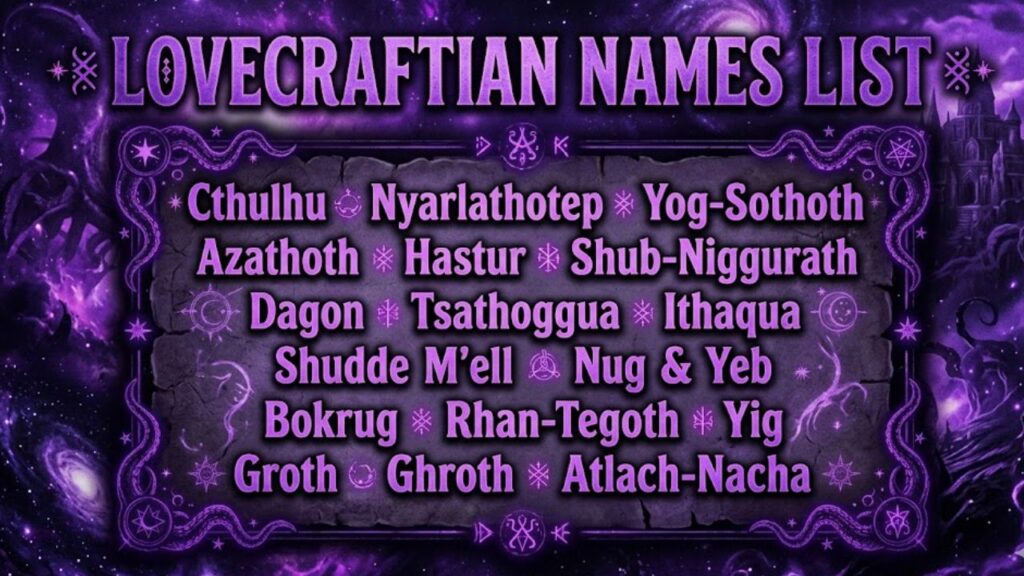
A great lovecraftian name generator pulls inspiration from H.P. Lovecraft’s own linguistic philosophy sounds that feel alien, ancient, and deeply wrong to the human tongue. Lovecraft believed names should carry weight beyond language. Use these as a foundation for any eldritch name generator project you’re building.
- Use apostrophes strategically they signal sounds humans physically struggle to produce.
- Combine harsh consonants like “kh,” “zh,” “ql,” and “th” for maximum alien dread.
- Keep names 6 to 12 characters short names feel human; longer ones feel cosmic.
- Avoid familiar syllables the moment it sounds like English, the dread evaporates.
- Layer meanings in roots pull from ancient Sumerian, Arabic, or invented phonetics.
- Kthulvarak: A slumbering titan beneath forgotten seas, radiating madness through ocean currents.
- Nyxaroth: Ancient whisperer of the starless void, bending minds with silent cosmic song.
- Vhorath: A cyclopean wanderer between dimensions, leaving sanity shattered in its wake.
- Zylqathar: Keeper of forbidden knowledge in deep ruins, older than the first star.
- Ugh’lazen: A shapeless hunger lurking between worlds, consuming light and logic equally.
- Drezhakhor: Risen from sunken cities, this ancient god commands tides and madness together.
- Pharyx’oth: A star spawn elder, weaving alien intelligence into the fabric of nightmares.
- Vorzyth: Tentacled guardian of the outer dark, silent and impossibly patient.
- Xal’thurak: Born of the void before time, existing only in the corners of dying minds.
- Qutharzel: A deep one patriarch, bridging the ocean’s horror with the surface world’s fragility.
- Yrvakoth: Cosmic storm entity, existing as sound rather than form or substance.
- Thrakk’ul: Servant of Azathoth, dancing blindly at the center of ultimate chaos.
- Olvrathas: Shapeshifting horror, wearing the skins of forgotten civilizations as casual disguises.
- Ghulvarak: Subterranean entity feeding on the psychic residue of human grief and fear.
- Nythukkar: Dreaming beneath the Antarctic ice since before mammals walked the earth.
- Zravothix: Outer god manifesting as impossible geometry, collapsing rational thought on contact.
- Kharoth’al: A whispering entity living inside radio static and electromagnetic interference.
- Morqathen: Entity of forbidden rituals, drawn by blood and astronomical alignment.
- Uxyvrath: Born in the space between galaxies, carrying starlight that poisons the mind.
- Thurvakhan: An ancient priest-god of the deep sea, commanding devotion through pure existential terror.
- Zothyriel: A haunting beauty wrapped in cosmic dread, worshipped in drowned temples.
- Vlakoreth: Outer darkness entity manifesting through fractured mirrors and still water.
- Xhorathul: A mind-eater born from the collective nightmares of a dying civilization.
- Qovanthal: Cosmic fog entity, consuming entire towns and erasing memory of their existence.
- Yrlothkhan: The Unblinking Watcher, whose gaze collapses time into a single terrible moment.
Fantasy Lovecraftian Names
Fantasy settings demand eldritch names that feel mythological yet profoundly wrong names that sound like they belong in ancient tomes rather than on any normal character sheet. A solid lovecraftian name generator approach for fantasy blends archaic resonance with alien phonetics, creating the sense that these beings existed before magic itself was named. These work perfectly for dark fantasy novels, TTRPG homebrew settings, or any world where the cosmic horror genre bleeds into high fantasy.
| Name | Type | Core Theme |
| Vorynthian | Ancient God | Void and starless depths |
| Khal’drathas | Elder Beast | Forbidden knowledge |
| Nyxolanthar | Dream Entity | Sleeping minds and nightmares |
| Thravekoth | Outer God | Cosmic storm and chaos |
| Zylvanthor | Great Old One | Cyclopean ruins and madness |
- Blend fantasy roots with Lovecraftian consonant clusters for dual-genre appeal.
- Use archaic suffixes like “-oth,” “-ar,” “-ix,” and “-ael” to create mythological weight.
- Avoid names that rhyme with common fantasy tropes distinction is everything here.
- Add impossible anatomy to the name’s implied meaning for deeper world-building.
- Consider how the name sounds aloud fantasy names need to be speakable in game sessions.
- Vorynthian: An elder titan of the void, walking where starlight has never reached.
- Khal’drathas: A horned cosmic entity worshipped in underground cities carved before recorded history.
- Nyxolanthar: Dream-weaver of impossible landscapes, trapping sleeping souls in beautiful, lethal illusions.
- Thravekoth: Storm god of the outer dark, manifesting as lightning shaped like screaming faces.
- Zylvanthor: Ancient cyclopean horror, whose very footsteps create permanent rifts in reality.
- Morthexar: Fantasy warlord touched by forbidden starlight, wielding weapons made of crystallized fear.
- Eldrythax: A wandering cosmic sorcerer whose spells were written before language was invented.
- Vaelkronn: Shape-stealing entity that wears the faces of those it has already consumed.
- Glorvanthas: A goddess of fractured time, existing simultaneously in all moments of history.
- Druulvaar: Subterranean god-beast feeding on the marrow of worlds and civilizations equally.
- Phoraltyx: A cursed scholar who unlocked forbidden knowledge and became something no longer human.
- Xathrovael: Cosmic horror wearing a crown of dead stars and whispering prophecies in static.
- Qilthrazaar: Entity of perpetual darkness, consuming fire and hope wherever civilization dares flourish.
- Ythrakael: A dream-touched oracle whose visions are madness wrapped in beautiful cosmic imagery.
- Zorquanthas: A void-born giant whose shadow alone drives entire villages into permanent insanity.
- Nathrovyx: Fantasy cultist who ascended through forbidden rituals into something beyond mortal classification.
- Ulvarkoth: Ancient horror sealed beneath a great mountain, slowly eroding its prison from inside.
- Vrakthoriel: A celestial entity whose song unravels the laws of physics wherever it travels.
- Thyrvakaan: Elder spirit inhabiting ancient standing stones, feeding on offerings of memory and time.
- Xolvranthas: Cosmic horror disguised as a mortal scholar, collecting the souls of the curious.
- Quorethvaan: Void-touched warrior whose blade was forged inside a dying star’s collapsing core.
- Akhlorith: Ancient fantasy god of woven curses, whose true form exists only in nightmares.
- Zylvrakaar: Outer entity that answers prayers but never in ways that feel like mercy.
- Tholvakrath: Legendary cosmic monster sealed in a book, freed only by reading its true name.
- Nyquoravel: Dream-trapped entity existing only in the space between sleeping and waking.
Lovecraftian Female Names
Female eldritch names carry a particular kind of haunting elegance they whisper of ancient power wrapped in terrifying grace. A truly great lovecraftian name generator for female characters combines softness of sound with the underlying wrongness that defines cosmic horror aesthetics. These names suit dark goddesses, corrupted oracles, deep one priestesses, void-born sorceresses, and any female entity whose beauty masks something genuinely incomprehensible beneath.
| Name | Character Type | Thematic Meaning |
| Nyxaria | Dark Goddess | Shadow and cosmic void |
| Thalvorah | Ocean Priestess | Deep sea and forbidden ritual |
| Erythna | Corrupted Oracle | Madness and celestial fire |
| Qivranthal | Void Sorceress | Space between stars |
| Zyrothael | Elder Dreamer | Ancient sleep and nightmare |
- Lean into flowing vowels balanced by hard consonants the contrast feels deliberately wrong.
- Use double letters like “yy” or “rr” where they feel unnatural, amplifying alien qualities.
- Draw from mythological feminine archetypes the dark goddess, the siren, the oracle and corrupt them.
- Names ending in “-ael,” “-ira,” or “-ya” feel feminine while retaining eldritch resonance.
- Consider the character’s function priestess, void goddess, star spawn queen and let it shape the name.
- Nyxariel: Goddess of the starless void, her voice alone fractures the sanity of those who listen.
- Thalvorah: Ocean priestess of the deep ones, conducting rituals beneath bioluminescent tidal caves.
- Erythna: Corrupted seer of the outer gods, beautiful and incomprehensible in equal measure.
- Qivranthal: A void-born sorceress who collects the names of lost gods as personal trophies.
- Zyrothael: Elder sleeper dreaming at the bottom of an ocean that exists in no known map.
- Morthixia: Dark matron of forbidden libraries, keeper of books written in forgotten alien scripts.
- Ulvryth: A dream-walker who inhabits the sleeping minds of scholars, driving them toward ruin.
- Yvahryx: Star spawn queen ruling a court that exists in the spaces between dimensions.
- Klyrvatha: A cosmic widow grieving the destruction of a universe that predated our own.
- Naethrix: Void-born huntress whose prey is not flesh but the concept of human sanity itself.
- Xorvytha: Ancient sorceress who traded her mortal soul for knowledge older than any civilization.
- Sylvraketh: A sea goddess of wrecks and drowning, beautiful as coral, cold as deep water.
- Thrivyara: Oracle of the outer dark, whose prophecies are always accurate and always devastating.
- Zolvraenia: Shapeshifter goddess of decay, worshipped by civilizations too desperate to care about consequences.
- Vurlethia: A psychic horror wearing the appearance of a kind woman, feeding on emotional trust.
- Qoryvael: Cosmic feminine entity whose weeping floods entire coastlines with salt and madness.
- Nyquireth: Star priestess conducting astronomical rituals that summon things from outside observable reality.
- Elyvrathas: Ancient horror disguised as a healer, offering cures worse than the original disease.
- Xilthvara: Dream goddess of the deep, her realm a labyrinth of sleeping cities and frozen time.
- Morthyxia: A void matron collecting the last breaths of mortals as currency in cosmic courts.
- Vyrakhael: Outer goddess of impossible beauty, whose true form requires multiple dimensions to contain.
- Thyrvixia: A corrupted muse who gifts artists with genius and madness in equal, devastating portions.
- Zaelvroth: Queen of the black stars, ruling a cosmic court that predates our universe entirely.
- Urvaxael: A siren-goddess of the void, her song audible only in the final moments of sanity.
- Olrythvara: Ancient feminine entity of fog and deep water, erasing the names of those she claims.
What Are the Most Unique Lovecraftian Names for RPG Characters?
If you play tabletop RPGs like Call of Cthulhu, Pathfinder, or D&D, you already know how much a great name elevates a character. A good lovecraftian name generator approach for RPG characters balances usability with dread the name needs to be sayable at a game table without killing the mood. Eldritch names for RPG use work best when they suggest a backstory, a corruption, or a connection to the Cthulhu Mythos without requiring a paragraph of explanation every session.
- Keep RPG names under three syllables unless playing a cosmic horror deity-level being.
- Use the name to signal alignment harsher names suggest aggression, softer ones suggest subtle corruption.
- Pair eldritch first names with unsettling surnames for human characters touched by the mythos.
- Consider pronunciation guides in your character notes players will thank you mid-campaign.
- Draw from actual Lovecraft surnames Whateley, Marsh, Gilman, Olmstead and corrupt them.
- Vorkal: A mercenary detective slowly losing their mind to visions from the outer dark.
- Thrazynn: An occultist who learned one too many names that shouldn’t exist in human language.
- Xolveth: A sailor who survived the sunken city and came back fundamentally, quietly wrong.
- Nyqorth: A scholar whose academic career ended when their research found something that wrote back.
- Druvakh: A cultist infiltrating a small New England town, absolutely convinced they’re saving everyone.
- Kelthrax: An investigator haunted by things glimpsed at the edge of a lantern’s flickering reach.
- Vrakael: A librarian who reads every book they catalogue and carries the weight of all of it.
- Zylvorn: A physician who believes the entity they study is benevolent and is completely wrong.
- Uxlareth: A deep sea salvage diver who brought something back from the wreck they shouldn’t have.
- Mortharyx: A painter whose subjects start appearing in other people’s nightmares without explanation.
- Thyrvann: An archaeologist who found a site predating every known civilization and chose to keep digging.
- Quolveth: A telegraph operator receiving messages in a language no known code book can translate.
- Xilvrax: A cult leader who genuinely believes their god loves them and is genuinely, horribly wrong.
- Zorvaleth: A musician composing a symphony whose third movement nobody who hears it ever survives.
- Nythvorn: A cartographer mapping places that shouldn’t geometrically exist in the known physical world.
- Vulraeth: A retired sailor who never sleeps anymore, afraid of what waits in the dreaming space.
- Thalvyx: An anthropologist studying deep one culture from the inside, slowly becoming what she studies.
- Ulkvareth: A coroner who sees patterns in the dead that no natural cause could logically explain.
- Khorvaan: A priest whose faith was replaced by something older and more demanding after a vision.
- Xorveth: An architect obsessed with building a structure whose geometry defies every known physical law.
- Yarqovath: A child raised in a cult who escaped and now inadvertently spreads what they fled.
- Morvyke: A detective who solved the case and immediately wished they hadn’t found the answer.
- Thraxvael: An astronomer who discovered something looking back through the telescope and couldn’t un-see it.
- Zylkrath: A traveling merchant selling items that don’t appear in any known catalogue of manufactured goods.
- Noquvareth: A librarian’s assistant who memorized a book that has since been proven to not exist.
Lovecraftian Monster Names
Cosmic horror creatures need names that feel physically wrong to say names that suggest anatomy no evolution on Earth could produce. A dedicated lovecraftian name generator for monsters should pull from the phonetic traditions of Lovecraft’s own bestiary: Shoggoth, Dhole, Byakhee, Shantak. These eldritch names carry the weight of impossible biology, alien hunger, and the specific kind of dread that comes from encountering something that doesn’t recognize you as anything significant.
| Monster Name | Creature Type | Defining Horror |
| Xhor’vakthal | Deep Sea Leviathan | Consuming ships and memories |
| Qlyvrath | Shapeless Crawler | Mimics the recently dead |
| Thurvakkel | Star-borne Flyer | Carries minds across dimensions |
| Zothruul | Fungal Entity | Replaces thoughts with spores |
| Yrlvakath | Dream Predator | Hunts inside sleeping minds |
- Monster names benefit from heavy consonant clusters the sound should feel difficult and violent.
- Use body horror phonetics guttural stops and fricatives suggest impossible, wet, wrong anatomy.
- Reference creature behavior in the etymology Shoggoth, for example, implies formless absorption.
- Layer names with implied scale longer names suggest larger, more ancient, more terrible creatures.
- Avoid cute sounds entirely even one soft syllable undermines the dread a monster name needs.
- Xhor’vakthal: Oceanic leviathan consuming coastlines, its body too large to comprehend as a single thing.
- Qlyvrath: Shapeless crawler that mimics the recently dead with just enough wrongness to cause maximum horror.
- Thurvakkel: Star-borne flyer transporting minds across dimensions, keeping bodies behind as hollow, still-breathing husks.
- Zothruul: Fungal horror replacing its host’s thoughts with colonies, turning people into walking spore dispensaries.
- Yrlvakath: Dream predator hunting the specific neurological pattern of creative minds during their deepest sleep.
- Ghulrakthar: Subterranean digger creating tunnel networks that exist in non-Euclidean geometry beneath every major city.
- Morthvakul: Tide-summoned horror drawn by specific moon alignments and the sound of drowning at sea.
- Vraxkothal: Star spawn soldier of the outer gods, descending during specific astronomical events to clear civilizations.
- Xilkraveth: A multi-limbed horror that communicates through vibrations in the frequency that causes human vertigo.
- Thulyrkoth: An ancient beast sealed inside a glacier, dreaming its hunger into the minds of passing explorers.
- Qorvakthal: A creature that exists at precisely the frequency between what human eyes can and cannot see.
- Nythvrakul: An entity made entirely of solidified cosmic radiation, burning with light that blinds and maddenes.
- Zvorthrax: An apex predator of the dreamlands, consuming entire shared dream landscapes in one slow inhalation.
- Urkhoveth: A biomass horror absorbing all organic matter it contacts and slowly, deliberately, growing more human.
- Xorvakthal: Ancient sea monster whose translation across three dead languages means simply: “the regret of the ocean.”
- Khlvraketh: A creature whose bones exist slightly outside normal space, making it functionally impossible to wound.
- Dravulkath: Psychic predator feeding on the specific neurological charge of human wonder, leaving hollow intellectuals behind.
- Ythvrakahn: Mountain-dwelling horror mistaken for geology by the cultures living in its stomach for centuries.
- Qilthravath: A swarm entity that appears as weather specifically as a fog that knows where you are.
- Morkthalvyx: Ancient cosmic horror mistaken for a god by seventeen separate civilizations, all of which ended badly.
- Zlyvraketh: An entity that exists only when observed, growing more real and more dangerous with each viewer.
- Xorvykthal: A deep one brood-mother radiating psychic compulsion, drawing coastal populations toward the water.
- Thraqvuleth: Void-born parasite attaching to human consciousness and slowly, methodically, replacing the original personality.
- Urlkvoreth: An invisible horror moving through walls, leaving behind a smell of ozone and the feeling of being watched.
- Noquvraketh: An entity so ancient that its name, spoken aloud, causes memory loss in everyone who hears it.
Lovecraftian God Names
The Great Old Ones and Outer Gods of Lovecraft’s Cthulhu Mythos represent the highest tier of cosmic horror naming. Azathoth, Nyarlathotep, Yog-Sothoth, Shub-Niggurath these aren’t just names. They’re phonetic architecture designed to imply beings so vast and alien that human language fails them entirely. A top-tier lovecraftian name generator for deity-level entities needs to push language to its breaking point. These eldritch names work for the most powerful beings in any cosmic horror setting.
- God names benefit from compound structures combine two alien words to suggest dual cosmic domains.
- Hyphenation and apostrophes signal complexity beyond single-concept deities they rule more than one truth.
- Invoke astronomical scale in the etymology reference stars, voids, or geological time in the name’s implied origin.
- Avoid meanings that are too literal the best god names remain deliberately obscure and ominous.
- Consider forbidden titles Lovecraft’s gods had epithets like “The Blind Idiot God” that amplify the name’s dread.
- Xyl’varak-Noth: The god of the space between galaxies, existing as the silence between cosmic events.
- Qoth-Lurazar: Ancient blind deity dancing at the center of a universe it does not know it rules.
- Thyrvak-Ulhor: The Unblinking Void, a god whose attention alone causes matter to behave incorrectly.
- Zar’ythmorak: Star-eater deity whose hunger predates the first stellar formation in observable cosmic history.
- Nvyrk-Ulothas: God of impossible geometry, whose temples can only be entered by approaching sideways.
- Khal’vrakthor: The Crawling Throne, a deity that exists as an ecosystem rather than a single entity.
- Yrl’vothkaan: God of the dreaming deep, whose thoughts manifest as civilizations across multiple dimensions simultaneously.
- Xorvak-Nythul: The Hollow Sun, a deity consuming stars from inside and wearing their light as a mask.
- Thurak-Zolvaar: God of entropy, patiently unraveling the laws of physics one constant at a time.
- Morqethal-Nvyx: The Weeping Dark, a god whose sorrow manifests as cosmic radiation across vast stellar distances.
- Qilth-Vrakazaan: Ancient fertility god of the outer dark, spawning realities rather than living creatures.
- Zylvar-Khothan: God of forbidden libraries, every book in existence being a single page of its autobiography.
- Uxrak-Velthonn: The Thousand-Eyed Nothing, a deity whose sight covers every moment across all possible timelines.
- Nythvrak-Ulzaan: God of endings, who predates the concept of beginning and will outlast the concept of conclusion.
- Thyrak-Ulvoreth: The Last Sound, a deity whose domain is the final noise made by dying civilizations.
- Xolvrak-Nythaar: The Geometric Hunger, a god whose form is a mathematical equation nobody can solve and survive.
- Zothrak-Uurvar: Ancient deity of tides and madness, controlling ocean behavior across seventeen planetary systems.
- Qovrak-Iltharaan: The Name-Eater, a god consuming identity as sustenance and leaving un-persons in its cosmic wake.
- Vrakth-Ulnyzaar: God of the pause before catastrophe, dwelling in the specific second before everything collapses.
- Ythrak-Molvaan: Outer deity of magnetic fields, subtly redirecting civilization’s development across geological time scales.
- Khorvak-Nythaar: The Dreaming Abyss, a god asleep since before the first star and still dreaming wars.
- Xyrth-Ulvrakaan: God of translation errors, causing misunderstanding between civilizations that would otherwise find peace.
- Nvythrak-Zoluar: The Cosmic Archivist, collecting last thoughts of dying gods as a personal, incomprehensible hobby.
- Thurvak-Xilnoth: God of the second dimension, existing as pattern rather than form or substance or location.
- Zylrak-Molvethaan: The Forgotten Cause, a deity responsible for events so ancient that causality itself forgot its involvement.
Why Do Writers and Gamers Love Eldritch Name Generators?
Creative people are drawn to eldritch name generators for a reason that goes beyond convenience. When you’re deep in a writing project or a long campaign, naming creative blocks are genuinely draining. A lovecraftian name generator breaks that wall instantly, delivering names that carry atmosphere right out of the box. Beyond convenience, eldritch names serve a storytelling function they signal to your audience that what they’re encountering exists outside the familiar taxonomy of fantasy creatures and gods.
- Name generators save hours of linguistic research and creative energy in time-sensitive projects.
- Eldritch names establish tone immediately readers and players recognize cosmic horror aesthetics instinctively.
- Generators provide starting points, not final answers the best writers modify generated names to fit their vision.
- Consistency is easier when you draw from a systematic approach to Lovecraftian phonetics and structure.
- The right name unlocks characterization writers frequently report that finding the name opens up the entire character.
The specific appeal of cosmic horror naming lies in the philosophical idea embedded in Lovecraft’s approach. He believed that human language could not contain the reality of truly alien beings. So every name that twists pronunciation, defies familiar syllable patterns, and resists easy recall is actually doing thematic work. It’s not just weird spelling it’s narrative philosophy made phonetic. That’s why eldritch name generators remain popular tools for horror writers, game masters, and world-builders who want their cosmic dread to feel earned rather than decorative.
Unique Lovecraftian Names
Truly original eldritch names stand apart from the crowd because they refuse familiar patterns. The best results from any lovecraftian name generator approach involve deliberate subversion taking what sounds almost familiar and making it profoundly wrong. These unique names work for projects that need fresh cosmic horror identity rather than names that echo too closely to Lovecraft’s published mythology. Think of these as the next generation of the mythos, extended by creative voices who understand the core philosophy.
- Swap expected letters for phonetically similar but visually jarring alternatives “k” for “c,” “y” for “i.”
- Combine language roots from unrelated families a Norse root fused with an Arabic ending feels genuinely alien.
- Use numbers of syllables that feel slightly off three and a half doesn’t exist, but names that feel like it do.
- Build in silent letters that imply sounds human mouths can’t make, suggesting non-human vocal anatomy.
- Test the name by saying it aloud if it trips on your tongue in an interesting way, it’s working correctly.
- Xolvryth: A name that sounds almost like a word in three languages simultaneously, meaning nothing in all of them.
- Nyqvarthel: Unique horror entity existing as a question that reality keeps accidentally asking itself.
- Khorvylaan: An ancient name found carved in a cave that predates any known human civilization by millennia.
- Zylvrakthor: A cosmic entity so unique that even other eldritch beings avoid it out of something like unease.
- Throvakelyn: An outer entity named by the last person to see it, in the last moment they were coherent.
- Qorvythaal: Unique void-born creature that exists in only the exact frequency of a specific childhood fear.
- Uxvaryth: An eldritch being whose uniqueness is that it remembers every civilization it has outlasted, in detail.
- Morqelvaan: A god-thing so unique that it spawned an entirely new branch of cosmological philosophy just by existing.
- Zylkhorveth: Unique entity that predates the concept of uniqueness and finds the idea quietly insulting.
- Nvarthykal: An outer god so specific in its domain that it rules only the emotion felt during solar eclipses.
- Xilrvakaan: A cosmic entity that changes completely with each observer, being whatever each individual most fears at depth.
- Thuryvakoth: Unique horror that evolved from the collective unconscious of a species extinct before Earth formed.
- Qylvraketh: An entity so singular in the cosmos that other outer gods refer to it with the equivalent of a shrug.
- Vorthykaan: A shapeless unique entity that has never appeared the same way twice in recorded cosmic horror history.
- Zyxvralkan: A name generated at the intersection of five dying languages, meaningful in none and terrible in all.
- Nvyrthakael: Unique dream entity that feeds specifically on the ambition of creative mortals, leaving productive emptiness.
- Xorvlyketh: An ancient name scratched into the hull of a ship found drifting, completely empty, in perfectly calm water.
- Thralvykaan: A cosmic entity that uniquely chooses its victims not by proximity but by intellectual curiosity and appetite.
- Qovylthaar: An outer being so unique that its cult’s holy text contradicts itself on every single page, intentionally.
- Zyrvakthar: A horror entity that uniquely grows more powerful the more people learn about it, making study dangerous.
- Ulkvorthaan: A void entity of unique patience, willing to wait geological ages for its specific, unnamed desire.
- Nythvalkaan: A cosmic being so unique it exists in the grammar of languages rather than in physical or metaphysical space.
- Xylvrakoth: Unique god-horror that communicates exclusively through statistical improbabilities impossible coincidences that gradually increase in frequency.
- Zolvyrthaan: An entity so unique it inspired a philosophical movement dedicated entirely to the problem of naming unnameable things.
- Qorthyvaan: A cosmic unique entity whose true name causes the speaker to forget their own name permanently.
How Does a Lovecraftian Name Generator Actually Work?
People search this question constantly because the mechanics behind eldritch name generators are genuinely interesting. A good lovecraftian name generator doesn’t just randomize letters it applies systematic linguistic rules drawn from Lovecraft’s own naming philosophy and the broader Cthulhu Mythos tradition. Understanding how the system works helps you create your own names when a generator isn’t available or when you need something precisely tailored to your project.
The core algorithm behind most eldritch name generators works by combining phoneme pools drawn from the specific sounds Lovecraft favored: guttural fricatives, glottal stops represented by apostrophes, unusual consonant clusters, and vowel patterns that deviate from standard English. Tools like these categorize sounds by “alien quality” the degree to which a phoneme resists natural human speech patterns. The best generators weight these phonemes by position, ensuring names start and end in appropriately unsettling ways.
Beyond pure phonetics, sophisticated generators layer in structural rules. Names for gods get longer and more compound. Monster names front-load harsh consonants. Human cultist names stay closer to recognizable patterns with subtle wrongness worked into the middle or end. This structural hierarchy mirrors Lovecraft’s own approach Cthulhu feels like a deity, Shoggoth feels like a creature, Whateley feels like a corrupted human. The eldritch name generator philosophy makes these distinctions systematically rather than intuitively.
If you’re building names manually, the practical approach is: choose two to three phoneme clusters from the harsh category (“kh,” “vr,” “xl,” “ql”), add a vowel bridge using “y,” “u,” or “a,” then end with an appropriate suffix. For gods: “-oth,” “-aan,” “-akhor.” For monsters: “-eth,” “-ax,” “-rath.” For humans: “-ey,” “-ard,” “-ane” with a corrupted middle section. This is essentially what any good lovecraftian name generator does computationally and you can do it creatively with equal results.
Lovecraftian Names for Places
Haunted geography is half of cosmic horror’s power. Lovecraft understood that the place where horror occurs carries as much dread as the entity itself. Arkham, Innsmouth, R’lyeh these names do something specific. They feel like real places that shouldn’t be real. A dedicated lovecraftian name generator for locations should blend New England geography aesthetics with alien phonetics, creating places that feel simultaneously familiar and profoundly, geographically wrong.
| Place Name | Location Type | Horror Theme |
| Vrakhoven | Coastal Town | Deep one infiltration |
| Xilnoth’s Deep | Ocean Trench | Submerged ancient city |
| Thyrvak’s Reach | Arctic Expanse | Frozen elder god site |
| Nullhaven | Abandoned Settlement | Collective disappearance |
| Qorvenmore | Inland Valley | Geological cosmic horror |
- Combine place-name conventions with alien syllables “haven,” “moor,” “wick,” “hollow” all work well.
- Imply geographic wrongness names suggesting the wrong scale, the wrong direction, the wrong permanence.
- Use possessive forms “X’s Deep” or “Y’s Reach” implies something claiming the geography as its own.
- Coastal and ocean names amplify deep one and Cthulhu Mythos connections most effectively.
- Abandoned or ruined descriptors built into the name suggest horror through etymology alone.
- Vrakhoven: A coastal fishing town where the catch has been inexplicably abundant for three consecutive centuries.
- Xilnoth’s Deep: An ocean trench mapped once and then deliberately removed from every subsequent navigation chart.
- Thyrvak’s Reach: An Arctic expanse where explorers consistently report navigational instruments behaving as though north has moved.
- Nullhaven: A settlement recorded in census documents until 1893, after which all records simply cease mid-sentence.
- Qorvenmore: An inland valley where the geological formations are symmetrical in ways that no natural process explains.
- Dravulwich: A small university town whose library has a restricted section that the librarians refuse to discuss.
- Xorvenmarsh: A wetland area where the fog consistently forms geometric patterns and doesn’t dissipate at sunrise.
- Thyrvakmore: A moorland expanse where hikers consistently report hearing music with no identifiable source or direction.
- Ulkvorton: A harbor town where every building faces the water, including the ones built before the harbor existed.
- Zylvrak’s Hollow: A wooded depression where no birds nest, no animals den, and compasses spin freely.
- Morthraven: A quiet village where the population never changes births and deaths apparently balanced with impossible precision.
- Khorvenmere: A lakeside settlement where the water is always perfectly still regardless of wind speed or weather.
- Xilkvorth: An island appearing on maps made before the relevant ocean was charted by any known civilization.
- Thalvrakmoore: A highland location where the stone formations rearrange themselves between winter surveys.
- Nvyrthhollow: A forested valley where the trees grow in patterns that, viewed from above, form symbols in no known alphabet.
- Qolvrawick: A coastal village where the fishing boats always come back full, and the fishermen never speak about why.
- Zyrvakthal: A mountain whose summit has never been successfully photographed despite dozens of documented attempts.
- Urkvorton: A town where the church records go back further than the settlement’s known founding date.
- Xorvenmere: A lake whose depth varies between surveys in ways that hydrologists describe as “professionally unsettling.”
- Dralvykhaven: A port town where ships arrive from ports that don’t appear in any current maritime directory.
- Morthvakmore: A moorland region where two separate geological surveys produced completely different, irreconcilable maps.
- Thurvakhollow: A forest clearing perfectly circular, perfectly level, and completely silent even during storms.
- Qylvrakthal: A mountain range that appears on satellite imagery one meter further west each consecutive year.
- Nvyrthwich: A village where every resident has the same recurring dream but refuses to discuss its content.
- Xorvenmoor: A bogland where objects dropped always resurface sometimes weeks later, sometimes decades, never immediately.
What Makes an Eldritch Name Sound Truly Terrifying?
The phonetics of terror aren’t random they’re systematic. Great eldritch names share specific acoustic properties that trigger primal unease in listeners and readers. Linguists studying horror fiction note that names causing the most dread consistently front-load hard stops and fricatives, include apostrophes implying sounds outside normal human phoneme range, and resist the natural stress patterns English speakers expect. The best lovecraftian name generator systems embed all of this intentionally. Understanding the mechanics makes you a better creator of cosmic horror naming in any context.
The key principle is controlled wrongness. A name like “Cthulhu” works because it looks almost like it follows rules, then violates them in the specific moment you try to pronounce it. The “Cth” cluster doesn’t exist in English phonology. Your brain reaches for familiar patterns and finds a void where they should be and that cognitive stumble produces genuine unease. The same mechanism operates in “Nyarlathotep.” “Ny” exists, “arla” nearly exists, “thotep” is almost Egyptian but combined, the full name exists in no human language’s comfort zone.
Apply this to your own naming by deliberately placing the phonetic wrongness in the most prominent position the start, a stressed syllable, or the final sound. Names that end wrongly tend to linger in the mind. “Shoggoth” works partly because “-ggoth” is a suffix cluster that English has no legitimate use for, so the brain keeps returning to the word trying to categorize it correctly and failing. That failure is the eldritch name generator‘s most powerful tool: controlled, deliberate unresolvability.
Cool Lovecraftian Names
Not every project needs maximum dread. Sometimes you want eldritch names that carry a cool, menacing edge rather than full psychological horror. These names work perfectly for character handles, usernames, game avatars, band names, or any creative project that wants Lovecraftian aesthetics rather than full cosmic horror commitment. A lovecraftian name generator for cool names focuses on the sonic satisfaction of the phonetics over their dread-inducing function.
- Cool eldritch names balance strangeness with memorability they should stick in the mind for positive reasons.
- Shorter cool names hit harder two or three syllables with strong consonants deliver maximum impact efficiently.
- These work as usernames and handles because they’re distinctive without being incomprehensible.
- Cool names can carry ironic distance slightly too strange for ordinary use, perfectly calibrated for internet culture.
- The best cool eldritch names function as both first impression and worldbuilding shorthand simultaneously.
- Vraketh: Clean, sharp, and unsettling in exactly the right proportion for any creative project.
- Nyxvorn: Cool cosmic darkness energy, perfect for a character who operates in morally complex shadow.
- Xolvar: Two syllables of pure eldritch cool, suggesting power without the full weight of horror.
- Thryxael: A name that sounds like it should be a sword but turns out to be something much worse.
- Zylvorn: Cool alien resonance, sitting perfectly between familiar and wrong in the most satisfying way.
- Korveth: Sharp and cool with an implied history of survival against things nobody else has survived.
- Uxvaar: Minimalist eldritch cool two syllables carrying more dread than most names three times their length.
- Morthyx: Cool and dark with a finality built into the ending that makes it excellent for villains.
- Xyrvel: Cool cosmic energy with a lightness unusual for the genre, perfect for an anti-hero character.
- Thalvorn: Cool deep water resonance calm on the surface, genuinely unsettling beneath.
- Zolvreth: A cool name with mechanical precision, suggesting an entity that operates with terrifying efficiency.
- Nvyxkael: Cool eldritch aesthetic with just enough linguistic strangeness to signal mythos knowledge.
- Khorvyx: Cool villain energy short, punchy, and impossible to mishear or misremember in context.
- Xilvraan: Cool and elongated, suggesting deep patience and the specific menace of things that wait.
- Thurvyx: Cool monster aesthetic with hard stops that feel like physical impact when spoken.
- Zorvael: Cool and graceful an eldritch name with unexpectedly beautiful phonetics hiding genuine darkness.
- Ulvrakn: Cool and compressed, a name that sounds like it started longer and was deliberately shortened.
- Nythvael: Cool dream-horror aesthetic soft enough to whisper, wrong enough to cause unease doing so.
- Xorval: Cool, clean, and cosmically indifferent a name that doesn’t care if you can pronounce it.
- Thyrvyx: Cool and final-sounding a name that implies the conversation ending badly for most participants.
- Qolvaan: Cool alien cool sounds like a title in a language nobody has spoken for ten thousand years.
- Zylvrak: Cool and territorial, suggesting a name claimed rather than given, earned through cosmic circumstance.
- Uxvorn: Cool minimalism with maximum eldritch implication two syllables holding an entire forbidden history.
- Morthryx: Cool dark energy, perfect for a character operating outside conventional morality’s jurisdiction entirely.
- Xyrthvaan: Cool and compound, suggesting a being with dual nature one aspect visible, one permanently hidden.
When Should You Use Lovecraftian Names in Your Creative Work?
Timing and context determine whether eldritch names elevate your project or distract from it. A lovecraftian name generator gives you names but knowing when to deploy them is creative intelligence that no tool can fully provide. The strategic use of cosmic horror naming is a craft skill, and getting it right transforms good work into genuinely unsettling, memorable storytelling.
Use lovecraftian names when you want to signal to your audience that they’ve left familiar genre territory. The moment a character with an ordinary name encounters something named Xolvrakthar, readers feel the shift in the story’s register. That shift is doing narrative work it marks the boundary between the normal and the incomprehensible. Reserve eldritch names for entities and places that genuinely warrant them. Overuse dulls the effect; every name sounding alien makes nothing feel special.
In RPG settings, deploy eldritch names for enemies and locations, but keep player character names more accessible. The contrast between recognizable character names and incomprehensible enemy names reinforces the cosmic horror dynamic players feel small against things whose names alone resist pronunciation. For fiction, introduce eldritch names gradually, letting the reader’s discomfort build with each encounter. A name encountered twice is remembered; encountered five times, it starts to feel like a presence. That accumulation of dread through repetition is one of Lovecraft’s most underrated narrative techniques, and it begins with the name.
FAQs
What is a Lovecraftian Name Generator?
A lovecraftian name generator is a tool that creates names inspired by H.P. Lovecraft’s cosmic horror style. It uses alien phonetics, harsh consonants, and unusual letter combinations to produce eldritch names that feel ancient, unsettling, and otherworldly for any creative project.
How Do I Create My Own Lovecraftian Name Without a Generator?
You can create your own lovecraftian name generator-style name by combining harsh consonant clusters like “kh,” “vr,” or “xl” with vowel bridges and suffixes like “-oth” or “-aar.” The goal is a name that sounds wrong in a controlled, interesting way that resists easy pronunciation.
Are Eldritch Names the Same as Lovecraftian Names?
Eldritch names and lovecraftian names are closely related but not identical. Eldritch refers to anything strange or supernatural, while Lovecraftian specifically follows the naming philosophy of H.P. Lovecraft’s Cthulhu Mythos alien, unpronounceable, and implying beings beyond human comprehension.
What Are the Best Lovecraftian Names from H.P. Lovecraft Himself?
The most iconic names directly from Lovecraft’s work include Cthulhu, Nyarlathotep, Azathoth, Yog-Sothoth, and Shub-Niggurath. These names from the Cthulhu Mythos define the lovecraftian name generator aesthetic alien phonetics, apostrophes, and sounds that resist natural human speech patterns.
Can I Use Lovecraftian Names in My Tabletop RPG Campaign?
Absolutely. Lovecraftian names and eldritch names are widely used in tabletop RPGs, particularly Call of Cthulhu, Pathfinder, and D&D campaigns with horror themes. Using a lovecraftian name generator helps maintain consistent cosmic horror atmosphere throughout your sessions.
What Makes a Name Sound Lovecraftian?
A name sounds Lovecraftian when it uses guttural consonants, apostrophes signaling alien speech breaks, unusual letter clusters, and phonemes that resist standard English pronunciation patterns. The best lovecraftian name generator results feel almost pronounceable the “almost” is precisely where the cosmic dread lives.
Are There Lovecraftian Names for Female Characters?
Yes eldritch names for female characters often balance flowing vowel sounds with hard consonants, creating names that feel simultaneously graceful and wrong. A good lovecraftian name generator approach for female entities uses suffixes like “-ael,” “-ira,” “-ya,” and “-vorah” to create haunting, distinctly feminine cosmic horror names.
Conclusion
Finding the right lovecraftian name generator approach whether you’re using a tool or crafting names manually transforms your creative work in ways that go far beyond simple naming. A great lovecraftian name signals genre, establishes atmosphere, and creates the specific kind of dread that Lovecraft spent his career perfecting. Eldritch names carry philosophical weight. They tell your audience that what they’re encountering exists outside the boundaries of familiar language, familiar logic, and familiar fear.
Every lovecraftian name in this article was built on the core principle that controlled wrongness creates more genuine horror than random strangeness. The best eldritch name generator philosophy whether computational or creative works from that same foundation. Use these names as starting points, modify them to fit your vision, and trust the phonetics to do their ancient, unsettling work. The cosmos is vast, indifferent, and full of things that deserve names as strange as they are. Now you have them.