
Have you ever stared at a blank character sheet or a baby name list and felt something was missing like the name you chose just didn’t carry enough magic? That feeling is real, and you’re not alone. Female elven names hold a kind of quiet power that few other name categories can match.
They’re musical, layered with meaning, and rooted in centuries of myth and fantasy lore. Whether you’re building a D&D character, writing a fantasy novel, or simply drawn to the beauty of elvish language, female elven names speak directly to the soul.
This article covers everything you need from elf names girl options for every personality type to deep-cut lore names from Tolkien’s Sindarin language, D&D fifth edition, wood elf traditions, dark elf mythology, and much more.
You’ll find names with meanings, tables for quick scanning, and enough variety to find the one that feels perfectly right. Keep reading your perfect elven name is already here.
Beautiful Female Elven Names With Meanings
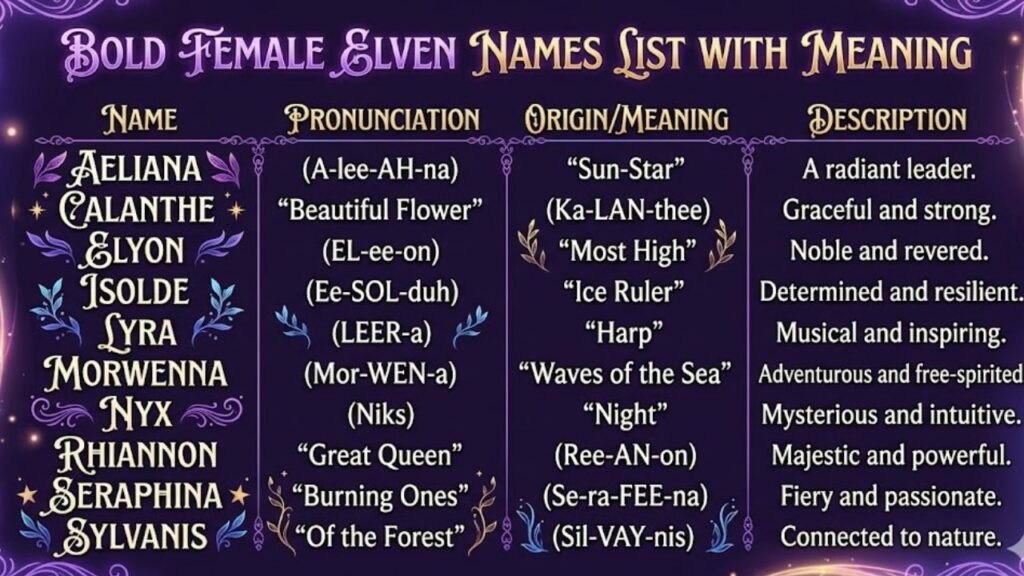
There’s something undeniably enchanting about a name that sounds like it was born in a forest at twilight. Female elven names carry that magic naturally, blending soft consonants with flowing vowels to create something both elegant and fierce. If you’ve been searching for elf names girl options that feel genuinely meaningful and not just randomly generated, this section is for you. Every name here reflects the grace, power, and mystery that define the elven spirit.
- Choose names with flowing vowels like ae, iel, or wen for an authentic elvish sound.
- Short names like Lyra or Aerin work well for quick recall in gaming sessions.
- Longer names like Anarielë or Celebrindal carry a noble, high-born feel.
- Nature-rooted names connect the character to wood elf traditions and forest magic.
- Meaning matters a name rooted in light, stars, or wisdom deepens character identity.
- Aelindra: Soft and graceful, meaning “daughter of the river’s song,” tied to healing waters.
- Sylvara: Woodborn and wild, this name means “she who belongs to the silver forest.”
- Liriel: Delicate and musical, evoking moonlight dancing across an ancient elven pond.
- Caladwen: From Sindarin roots, meaning “pure light,” worn by scholars and seers.
- Miriel: Shining and gentle, meaning “jewel daughter,” a classic among high elven courts.
- Thalindra: Bold and ancient, this name carries the weight of long-forgotten elven empires.
- Eryniel: Literally “forest daughter,” the perfect choice for a wood elf ranger character.
- Naeris: Rare and whispery, suggesting deep intuition and elven foresight.
- Vanyalin: Meaning “fair one of the golden folk,” rooted in Tolkien’s Quenya tradition.
- Solindë: Radiant and warm, evoking the sun rising over elven treetop cities.
- Faelindra: Graceful and spirited, meaning “brave spirit of the wild wind.”
- Anariel: “Sun daughter” in Quenya noble, radiant, and endlessly inspiring.
- Gwaedhiel: Ancient Welsh-influenced name meaning “bond of the spirit realm.”
- Celenneth: Melodic and rare, evoking silver rivers flowing through moonlit valleys.
- Riniel: A tender, loyal name meaning “crowned with a garland of stars.”
- Lasgalen: Meaning “leaves of green” earthy, fresh, and deeply nature-connected.
- Nimloth: Pure and white as a flower, often given to healer elves of noble birth.
- Sariel: Angelic and otherworldly, meaning “princess of the moon’s quiet light.”
- Elenwë: Meaning “star person,” historically a revered name in Tolkien’s First Age.
- Finduilas: A sorrowful, romantic name from legend, carrying beauty and tragedy equally.
- Yavanna: Earthy and divine, meaning “giver of fruits,” tied to creation and abundance.
- Tinúviel: The name Beren gave Lúthien meaning “daughter of twilight” achingly beautiful.
- Gilraen: Meaning “wandering star,” worn by those who travel far from home.
- Aerindel: Soft and oceanic, suggesting a half-elf born between sea and sky.
- Neldoreth: Deep forest name, meaning “beech tree grove,” grounded and ancient.
High Elf Female Names for Fantasy Characters
High elves carry themselves like royalty and their female elven names reflect every ounce of that dignity. These names often run longer, include flowing Quenya-style vowels, and suggest lineage, magical power, and timeless beauty. Elf names girl picks in this category work brilliantly for queens, archmages, high priestesses, or any character who commands a room without raising her voice. High elven naming traditions borrow heavily from real-world Tolkien linguistics, making them rich in cultural depth.
| Name | Meaning | Best For |
| Arwen | Noble maiden | Half-elf royalty |
| Galadriel | Maiden crowned with radiant hair | Elven queen, seer |
| Celebrían | Silver queen | Noble high-elf matriarch |
| Idril | Sparkling brilliance | Scholar or archmage |
| Aredhel | Noble elf maiden | Warrior princess |
- High elf names often end in -riel, -iel, -wen, or -lë for linguistic authenticity.
- Long, multi-syllable names signal noble birth and ancient lineage in elven culture.
- Musical cadence is key these names should feel like they could be sung aloud.
- Pairing a high elf name with a grand surname like Elenathiel deepens world-building.
- Classic names from Tolkien’s lore like Arwen and Galadriel remain the gold standard.
- Celebrindal: Meaning “silver foot,” a legendary high elf name from the First Age wars.
- Anairë: “Most holy,” a Quenya name for priestly or spiritually gifted elven women.
- Eärwen: “Sea maiden” noble, rare, and deeply connected to ocean-born elven lineages.
- Indis: Simple but powerful, meaning “woman” a name worn by an elven queen herself.
- Finarfin: Adapted feminine form meaning “heir of Finwë,” carrying royal weight beautifully.
- Nerdanel: Wise and artistic, meaning “skilled one,” perfect for a craftsperson or mage.
- Lalwendë: Joyful and bright, meaning “laughing maiden,” rare among serious high elves.
- Elemmírë: “Star jewel” rare, precious, and worn only by the most gifted stargazers.
- Anduril-Iel: “Daughter of flame of the west,” perfect for warrior-queens of elven armies.
- Morwenna: Dark-beautiful, meaning “maiden,” blending shadow and grace naturally.
- Quenelda: Strong and proud, a Quenya-style name meaning “she who speaks elvish wisdom.”
- Vorindë: Patient and enduring, meaning “she who remains,” a name for long-lived matriarchs.
- Eldalótë: “Elven flower,” a poetic high elf name used in ceremonial traditions.
- Rilindë: “Crystalline song-maiden,” a name for elves gifted in music and high magic.
- Ailinon: Meaning “pool of clear water,” evocative of purity and divine connection.
- Nólofinwë: “Wise heir of Finwë,” adapted as feminine, for warrior-scholars of legend.
- Tindómiel: “Daughter of twilight,” ethereal and poetic, perfect for a moonlit elf heroine.
- Elenariel: “Daughter of the star field,” vast and awe-inspiring in every syllable.
- Curufinwë: Bold and driven, meaning “skilled spirit,” for a high elf obsessed with craft.
- Irissë: Sharp, mysterious, and wild meaning “woman of iron will” in Quenya tradition.
- Neniel: “Water daughter” flowing and calm on the surface, fierce beneath.
- Amáriel: “Morning child,” bringing hope and new beginnings to every scene she enters.
- Vardilmë: Meaning “devoted to Varda,” the queen of stars sacred and reverent.
- Serindë: “Needlewoman” a surprising, intimate name for an elf of extraordinary patience.
- Olossë: Cloud-born, meaning “like mist on the mountains,” soft yet unreachable.
Wood Elf Girl Names Rooted in Nature
Wood elves live by a completely different code than their high-born cousins. Their names are shorter, earthier, and deeply tied to the natural world rivers, trees, seasons, and wild animals. Girl elf names in this category carry an unpretentious strength. They don’t need grandeur because the forest itself is their inheritance. For rangers, druids, hunters, and wild-hearted characters, these female elven names feel absolutely right.
| Name | Nature Connection | Character Type |
| Elowen | Elm tree | Druid or healer |
| Sylvie | Of the woods | Scout or ranger |
| Tauriel | Young woman of the forest | Warrior or guardian |
| Aerith | Earth and wind spirit | Mage or herbalist |
| Brenna | Raven or dark-feathered bird | Spy or shadow hunter |
- Short, punchy wood elf names like Wyn, Fern, and Leaf echo the directness of forest life.
- Animal references such as “raven,” “hawk,” or “deer” enrich a wood elf’s identity.
- Seasonal names like Autumnwren or Solsticeborn add beautiful thematic depth.
- Tribal suffixes such as -fen, -bark, or -thorn pair well with wood elf first names.
- Earthy vowels a, e, o ground the name in soil, bark, and rainfall.
- Fenwren: A forest bird-watcher, meaning “wren of the marshlands,” quick and observant.
- Aelith: Celtic-inspired and earthy, suggesting an elf who reads the wind for direction.
- Briarwyn: Meaning “fair one of the thorns,” beautiful but unapproachably sharp.
- Mosshallow: Unusual and organic, worn by a wood elf born beside a shaded mossy creek.
- Thornvale: Bold and wild, a name earned through surviving the deep, dangerous forest.
- Clovenhoof: Mythic and animalistic, suggesting shapeshifting druidic heritage.
- Duskpetal: Poetic and tender, the name of an elf herbalist with rare healing gifts.
- Rowaneth: Rowan tree plus the elven suffix -eth, grounded and quietly powerful.
- Ferngale: Swift and airy, a wood elf scout name carrying forest speed and freedom.
- Ashwren: Meaning “born in the ash grove,” strong, resilient, and adaptable.
- Ivylorn: “She who is wrapped in ivy,” a name for a wood elf deeply bonded to ancient trees.
- Sedgewing: Rare and marsh-born, for an elf raised among reeds and shallow river waters.
- Hazelwend: Wandering and free, a name rooted in hazel groves and seasonal migration.
- Elmrose: Simple and beautiful, combining two forest elements into one gentle identity.
- Brookwyn: “Fair one of the brook,” lively and clear, always moving forward.
- Coppervine: Autumnal and warm-toned, for a wood elf with fiery red hair and a bold heart.
- Nightbloom: A name for a wood elf who thrives after dark, gathering flowers under moonlight.
- Stormleaf: Dramatic and strong, worn by a wood elf who survived the great forest tempest.
- Thornmist: Mysterious and borderline dangerous, for a wood elf tracker of quiet lethal skill.
- Petalforge: Creative and unusual, for a wood elf artisan who crafts with natural materials.
- Willowfen: Soft and sorrowful in tone, for a healer wood elf with a tragic backstory.
- Muskmere: Deep and earthy, the name of a wood elf born beside a still, dark forest lake.
- Quickbramble: Energetic and aggressive, for a wood elf warrior with unmatched forest speed.
- Embervale: Warm and autumnal, meaning “fire-lit valley-born,” radiant and grounded.
- Goldenfern: Sunlit and optimistic, for a wood elf raised on open hillsides above the treeline.
Dark Elf Female Names Mysterious and Powerful
Dark elves, or Drow, carry an entirely different energy. Their female elven names lean toward shadow, fire, and cold elegance. In D&D lore, Drow society is matriarchal, meaning girl elf names from this tradition carry genuine authority and danger. These names work brilliantly for antiheroes, morally complex characters, and villains with understandable motivations. Don’t sleep on the dark elf tradition these names are unforgettable.
- Drow names often use hard consonants z, dr, kh, x for a sharp, dangerous sound.
- Matriarchal titles like House prefixes or Ilythiiri roots add Forgotten Realms authenticity.
- Shadow meanings like “void,” “ember,” “venom,” and “obsidian” define dark elf naming culture.
- Short, snapping names like Zyn or Xar are common among young Drow warriors.
- Longer noble names like Viconia or Malice signal matriarch status in Drow society.
- Zylvara: Fierce and cold, meaning “daughter of the stone void,” a Drow warrior name.
- Nathyra: Meaning “spider’s whisper,” deeply tied to Lolth worship in Drow tradition.
- Eilistraee: The rare benevolent dark elf goddess name beauty in unexpected darkness.
- Vhaeraun: Adapted as feminine, meaning “the masked one,” for a Drow spy or rogue.
- Qilafae: Sharp-edged and fast, meaning “shadow-quick,” a name for Drow assassins.
- Szordrin: Heavy and dangerous, a matriarch name meaning “iron will of the deep dark.”
- Malice: Infamous in Forgotten Realms lore, the name of Drizzt Do’Urden’s cruel mother.
- Vlondril: Ancient and rare, carrying connotations of forbidden elven shadow magic.
- Xariel: Edgy and modern-feeling, meaning “child of the obsidian star,” perfect for antiheroes.
- Ilythyra: Full dark-elf linguistic roots, meaning “she who walks the path of shadow-fire.”
- Nilvra: Minimalist and cold, for a Drow who speaks little and means every word.
- Drezzyn: Harsh and warrior-coded, meaning “born in the deepest underdark tunnels.”
- Krexis: Exotic and intimidating, for a dark elf archmage of terrifying magical power.
- Faerzress: Named after the magical radiation of the Underdark rare and deeply lore-connected.
- Zauviir: Proud and sharp, a Drow house name adapted into a fierce personal first name.
- Yvonnel: Noble and calculating, the name of one of the most powerful Drow matriarchs ever.
- Sorn’daul: Meaning “blade of the goddess’s will” ceremonial and lethal simultaneously.
- Pellanis: Darker cousin of Elvish softness, meaning “she who carries the hidden flame.”
- Chalinthra: Long and commanding, perfect for a dark elf queen of the ninth Underdark tier.
- Rizolvyn: Complex and multilayered, suggesting a Drow with a hidden agenda and deep magic.
- Deiratha: Fluid yet cold, meaning “river of shadow beneath the mountain stone.”
- Khyraen: Rare, noble, and sharp worn by Drow diplomats navigating surface-world politics.
- Szulindra: Dramatic and full-voiced, the name of a legendary dark elf matriarch of war.
- Vrymzala: Exotic and unpronounceable to outsiders perfect for a secretive shadow mage.
- Obsidienne: French-touched and smoky, meaning “born from volcanic glass and deep shadow.”
What Are the Most Unique Female Elven Names in Fantasy Lore?
This is the question every serious fantasy writer and gamer eventually asks. Unique female elven names go beyond the standard lists they blend multiple linguistic traditions, invent new roots, and carry meanings that feel genuinely discovered rather than assigned. Girl elf names that stand out in a crowded fantasy world typically mix unexpected sounds with deeply resonant meanings. These are the names people remember long after the story ends.
| Name | Linguistic Root | Unique Quality |
| Vaelindra | Invented Elvish | Combines valor + tenderness |
| Aszuriel | Hebrew + Elvish | Otherworldly and celestial |
| Mornifindë | Quenya + Shadow | Dark wisdom archetype |
| Lyrindae | Celtic + Elvish | Musical and ethereal |
| Thalyssra | D&D lore-based | Modern, strong, recognizable |
- Blending linguistic roots creates genuinely unique names no generator will duplicate.
- Using rare phonemes like th, zh, or dh produces a distinctly non-English elven feel.
- Inventing compound names by joining two meaningful words deepens character identity.
- Testing names aloud reveals whether they sound musical or awkward in practice.
- Borrowing from Old Norse or Celtic gives names historical weight without copying fantasy clichés.
- Vaelindra: Invented Elvish for “valor of the tender spirit,” rare and genuinely surprising.
- Thessalwyn: Blending Greek geography with Elvish softness for a worldly, traveled elf.
- Aszuriel: Celestial and multi-rooted, meaning “azure star child of the upper heavens.”
- Mornifindë: Tolkien-influenced shadow name meaning “dark-haired finder of lost things.”
- Lyrindae: Musical, Celtic-touched, and deeply magical a bard’s name if there ever was one.
- Velanthra: Powerful and unusual, suggesting an elf born during a celestial alignment event.
- Zephyrael: Wind-born and angelic, meaning “breath of the divine wind above the world.”
- Thalyssra: D&D Nightborne lore name strong, regal, and immediately recognizable to gamers.
- Osirindë: Egyptian-Elvish blend meaning “she who rises again,” perfect for undead-adjacent elves.
- Quilindra: Rare and multi-textured, meaning “she of the sacred silver quill and ink.”
- Astrindel: Starlike and pointed, a name that carries the cold beauty of deep winter skies.
- Narindiel: “Fire daughter” with Quenya roots passionate, dangerous, and entirely her own.
- Voralindë: Invented and bold, carrying meanings of “devotion through the long dark night.”
- Eissyndra: Icy and precise, for an elf who commands both cold magic and cold logic.
- Rhuvindë: Welsh-Elvish blend, meaning “mystery flowing through the hidden mountain pass.”
- Caelithorn: Sky + thorn a contradiction that makes perfect sense for a fierce sky elf.
- Nerindë: Elegant and restrained, meaning “water-spirit of unbreakable inner calm.”
- Talvindra: Invented and strong, meaning “she who guards the boundary between worlds.”
- Quelindë: A soft but firm name meaning “bird-spirited daughter of the upper branches.”
- Frymezal: Strange and bold, for an elf who defies every naming convention deliberately.
- Lyssavra: Two-part and lyrical, combining “lyssa” (madness) with “avra” (breathe) chaotic beauty.
- Eináriel: Old Norse plus Elvish suffix, meaning “warrior daughter of the one who fights alone.”
- Sylvandris: Forest + star, for an elf born in the canopy, dreaming of the sky above.
- Cerindaë: Cerulean-inspired, meaning “blue-eyed daughter of the eastern morning light.”
- Wayvindra: Invented and flowing, for an elf with no fixed home and an open, wandering heart.
Cool Female Elf Names for D&D and RPG Characters
When you sit down at the table for a D&D session, your character’s name does real work. It sets tone, suggests backstory, and tells your dungeon master something before you say a word. Female elven names that work well in D&D tend to be memorable, pronounceable, and character-specific. Elf names girl choices for RPG use benefit from having a clear theme whether that’s mysterious, noble, playful, or deadly.
- Pronounceable names reduce table confusion and help other players engage with your character.
- Two-syllable options like Lyra, Faela, or Vynn are quick to say mid-combat session.
- Name meaning alignment a wisdom-aligned elf named Saelia feels more cohesive narratively.
- Avoid overused D&D names like Arwen or Legolas originality strengthens your character’s identity.
- Consider the class a rogue’s name should feel different from a cleric’s elven name.
- Vaeryn: Quick and memorable, this D&D staple name works for rogues, rangers, and scouts.
- Selavindra: Long and noble, for a paladin or cleric of high elven divine magic.
- Zylphir: Fast-sounding and mysterious, perfect for a D&D trickster or arcane trickster.
- Nym: Ultra-short and distinctive, a classic for an elf rogue with minimal backstory revealed.
- Lirien: Soft and musical, for a bard or sorcerer with a charismatic, crowd-winning presence.
- Quorra: Futuristic-feeling but lore-friendly, for a wildmage or chaos sorcerer elf.
- Thalvindë: Scholarly and careful, perfect for a high elf wizard with ancient spell research goals.
- Aeris: Immediately recognizable, memorable, and endlessly versatile across D&D classes.
- Faelindra: Warm and spirited, for a D&D elf paladin devoted to forest and fey deities.
- Xaerindel: Drow-influenced but surface-world-friendly, for a morally complex elf character.
- Sylvindra: Nature-coded and direct, for a wood elf ranger with survival-based skills.
- Vorvindë: Dark and arcane, for a warlock elf who made a pact with an ancient fey being.
- Caerith: Simple, gender-fluid-feeling, and versatile across all elven D&D subraces.
- Nessindë: Gentle and healer-coded, for an elven life cleric with a compassionate backstory.
- Daeris: Slightly dangerous-sounding, for a D&D elf who walks the line between orders.
- Trindaelith: Long and complex, for a character with an elaborate noble backstory to share.
- Sylnara: Earthy and strong, for a Circle of the Land druid with deep forest connections.
- Vexindra: Sharp and clever, for a D&D elf who uses her wit as readily as her weapons.
- Mirelis: Calm and graceful, for an elven wizard specializing in divination and future-sight.
- Zindara: Exotic and a little wild, for a half-elf with strong Drow ancestry and identity conflict.
- Thessivyn: Unique and clearly elven, for a character built around diplomatic intrigue.
- Relvindë: Rare and sonorous, for a D&D elven fighter-mage of ancient warrior bloodline.
- Aetherindal: Grand and magical, for a character tied to the Astral Sea or Feywild origin.
- Cairindel: Flowing and noble, for a high elf character committed to a strict code of honor.
- Lundrindë: Moon-touched and mysterious, for a D&D elf with lycanthropic or lunar magic.
Half Elf Female Names That Bridge Two Worlds
Half-elves occupy a special place in fantasy. Their female elven names often reflect the tension between two identities part human, part elf, fully neither and fully both. The best girl elf names for half-elves blend the musicality of elvish tradition with the simplicity of human naming conventions. These names feel approachable but carry an underlying depth that reveals their elven heritage on closer inspection.
| Half-Elf Name | Human Element | Elvish Element |
| Aerith | Common vowel structure | -ith elvish suffix |
| Lirien | Familiar feel | Flowing elvish tone |
| Serana | Familiar sound | -ana elven ending |
| Kaelindra | K-name familiarity | -lindra elvish root |
| Tessywyn | Tess (human nickname) | -wyn elvish suffix |
- Blend common human syllables with traditional elvish suffixes for authentic half-elf names.
- Names ending in -a, -ie, or -yn feel accessible to human ears while retaining elvish softness.
- Avoid over-complicating half-elf names their simplicity is part of their narrative identity.
- Human-world nicknames like Lira for Liraendë naturally fit the half-elf social experience.
- Half-elf names reflect belonging nowhere fully let that ambiguity live in the name itself.
- Aerith: Possibly the most beloved half-elf adjacent name in fantasy gaming history timeless.
- Serana: Warm, human-approachable, yet carrying clear elven warmth beneath the surface.
- Kaelindra: Strong K opening plus a deeply elvish finish balanced and memorable.
- Tessywyn: Sweet and slightly sad, for a half-elf who grew up between two cultures.
- Liriael: Borrowed from Garth Nix’s Abhorsen series, rich with literary and elvish resonance.
- Vaelora: Warm and slightly romantic, for a half-elf raised among humans who longs for elvish kin.
- Syriel: Short and graceful, blending human accessibility with clear elvish phonetic tradition.
- Alyndra: Familiar-feeling yet unmistakably elvish, for a half-elf who navigates both worlds.
- Rhysswyn: Welsh-influenced, for a half-elf from a coastal kingdom with strong human ties.
- Thessara: Greek-touched and elvish-finished, for a half-elf with scholarly ambitions.
- Calyssa: Soft and musical, for a half-elf bard who earns her living in human taverns.
- Naerindë: Melancholic and tender, for a half-elf who mourns the full elvish life she can’t live.
- Velisindra: Long and noble-sounding, for a half-elf born into a human aristocratic family.
- Liraviel: “Song-star,” a perfect name for a half-elf bard of exceptional natural talent.
- Sylindra: Earthy and grounded, for a half-elf raised in a border forest community.
- Therindë: Thoughtful and careful, for a half-elf who chose quiet wisdom over adventure.
- Caerwyn: Welsh plus Elvish, for a half-elf caught between Celtic-inspired and elven traditions.
- Miravindë: Mirror-beautiful, meaning “she who reflects both worlds clearly and without shame.”
- Aelyssara: Long and layered, perfect for a half-elf with a complicated, multi-generational backstory.
- Zindrael: Slightly edgy, for a half-elf with some Drow ancestry she’s only recently discovered.
- Rindaelith: Rare and nuanced, for a half-elf pursuing a quest to understand her elvish heritage.
- Orindra: Simple and strong, for a half-elf fighter who’s made peace with her dual identity.
- Falysswyn: Flowing and sad, for a half-elf who outlives all her human friends by centuries.
- Quelindra: Birdlike and gentle, for a half-elf who found her place among neither people.
- Elarindë: Star-rooted and graceful, for a half-elf who chose to live among full-blooded elves.
Why Do People Choose Elvish Names for Fantasy Characters?
The answer is simpler than you’d think. Female elven names carry instant atmospheric weight. The moment a player announces their character is named Aelindra or Sylvara, every person at the table imagines something green forests, ancient magic, silver moonlight. Elf names girl selections provide a shortcut to world-building because the sounds themselves carry established cultural meaning across decades of fantasy storytelling.
- Fantasy immersion deepens dramatically when names match the tone of the setting.
- Elvish names signal intelligence, wisdom, and longevity before the character speaks a word.
- Cultural resonance with Tolkien’s legacy makes elvish names universally understood in fantasy spaces.
- The musical quality of elvish naming traditions appeals even to non-fantasy audiences.
- Writers find that elvish names help them maintain character voice consistency throughout long projects.
Elven culture has permeated popular media from Lord of the Rings to The Witcher, Dungeons & Dragons, Elder Scrolls, and World of Warcraft. The naming traditions from these worlds have built a shared vocabulary that fantasy fans recognize and respond to emotionally. Choosing an elvish name is, in many ways, choosing a whole cultural tradition and that’s exactly what makes it so powerful.
What Makes a Name Sound Truly Elvish?
Great female elven names share a handful of consistent linguistic qualities that signal “elvish” to the ear almost immediately. Understanding these patterns helps you evaluate names and even create your own. Girl elf names that sound authentic consistently rely on specific phonetic patterns drawn from Tolkien’s Quenya and Sindarin languages, as well as Celtic, Nordic, and invented fantasy roots.
- Flowing vowel combinations like ae, ei, ui, ia, and oa create the signature elvish sound.
- Soft consonants l, r, n, m, v dominate genuine elvish phonetic tradition.
- Avoid harsh stops like k, g, b, p in sequence they disrupt the musical flow.
- Double consonants occasionally work, but single fluid consonants feel more authentically elvish.
- Nature-based meanings like light, star, leaf, river, or moon anchor names in elvish cultural identity.
Tolkien built Quenya and Sindarin with strict internal grammars, which is why his names feel so consistent and real. Modern fantasy writers replicate this by establishing naming rules for example, all names in a given elven clan end in -riel or begin with Ae-. This internal consistency is what separates genuinely elvish-sounding names from random letter combinations.
Moon Elf and Sun Elf Female Names
Moon elves and sun elves represent the celestial poles of elven identity. Moon elves carry cool, silver, nocturnal energy while sun elves radiate warmth, gold, and divine light. Both subtype traditions produce deeply evocative female elven names that work brilliantly in D&D’s Forgotten Realms setting. Elf names girl picks from either category carry instant visual and tonal associations for players and readers alike.
- Moon elf names typically reference silver, shadows, tides, dreams, and winter’s cold clarity.
- Sun elf names reference gold, fire, noon heat, summer abundance, and divine blessing.
- Moon elves tend toward cooler consonants; sun elves toward warmer, brighter vowel openings.
- Both traditions use -riel, -iel, and -indë suffixes for feminine names.
- Celestial symbolism in elven naming directly reflects the character’s magical affinities.
- Lunindë: Moon daughter, carrying the quiet authority of the full moon over still water.
- Silverwyn: Simple and striking, for a moon elf whose hair gleams like polished metal.
- Solariel: Radiant and warm, the perfect sun elf name for a warrior of divine light.
- Moonshadow: Romantic and poetic, for a moon elf rogue who hunts by night and dream.
- Goldenveil: Mysterious and sun-touched, for a sun elf who veils her true power carefully.
- Astrindiel: Pointing toward the stars, for an elf with celestial magic and cosmic awareness.
- Twilindra: Caught between sun and moon, for an elf born at the precise moment of dusk.
- Noctelindë: Night-blossoming and rare, for a moon elf herbalist who works at midnight.
- Dawnriel: Golden and hopeful, sun elf name meaning “she who arrives with the morning light.”
- Starlindra: Classic and clean, for an elf with strong connections to divine star-based magic.
- Cresyndra: Crescent-moon inspired, for a moon elf with shapeshifting or lunar transformation abilities.
- Radaelith: Radiance plus elvish root, meaning “shining light that carries across vast distances.”
- Lunaressë: Deeply moon-coded and musical, for a high moon elf of ancient celestial lineage.
- Heliondra: Sun-root and strong, for a sun elf warrior-mage of the elven golden armies.
- Eclipselindë: Bold and rare, for an elf born during a solar eclipse powerful and unpredictable.
- Solindra: Clean and golden, a sun elf name that sounds strong without being overbearing.
- Moonwhisper: Soft and tender, for a moon elf oracle who receives visions in silver water.
- Auroriel: Named for the northern lights, standing between sun and moon traditions perfectly.
- Vesperilindë: Evening-star inspired, for a moon elf who worships the first star of night.
- Gilraenë: Tolkien-influenced wandering star, perfect for a celestial elf on a long quest.
- Brightmere: Sun elf name meaning “she who illuminates the still waters of the morning.”
- Tisindria: Ancient and lunar, for a moon elf who keeps the calendar of tides and seasons.
- Suncrest: Vivid and visual, for a golden-haired sun elf general of the elven high armies.
- Luneth: Short and clear, for a moon elf rogue who prefers action to long elvish ceremonies.
- Solgaelith: Complex and bright, meaning “sun-wind daughter of the golden morning shore.”
What Are the Rarest Female Elven Names You Can Use?
Rarity in female elven names comes from three sources: obscure linguistic roots, original invention, and cultural specificity that most name lists never reach. If you want girl elf names that no one else at your game table or in your writing community will already be using, these are your best options. These names pull from Tolkien’s lesser-known First Age texts, obscure Celtic and Norse mythology, and carefully constructed invented elvish roots.
- First Age Tolkien names like Elenwë, Nerdanel, and Anairë appear in almost no name lists.
- Invented compound names that follow strict elvish phonetic rules feel rare yet authentic.
- Cross-mythological names blending Japanese, Arabic, or Swahili roots with elvish suffixes surprise everyone.
- Names ending in -ossë, -indë, or -almë are almost never used outside serious Tolkien scholarship.
- Names with internal meaning across multiple languages feel layered and genuinely rare.
- Nierellë: Rare Tolkien-adjacent name meaning “lady of the inner silent fire,” used almost nowhere.
- Suldolindë: Full Quenya compound meaning “wind spirit song,” rich and almost never encountered.
- Perilinossë: Multi-syllable rarity meaning “dancing light upon the far distant evening waters.”
- Varanthoindë: Invented and elaborate, for a world-builder seeking maximum linguistic depth.
- Qualorindë: “Swan-singer,” a name from Tolkien’s rare First Age feminine naming traditions.
- Yavindëlossë: Meaning “giver of blossoms on the wind” long, precious, and utterly unique.
- Thorindalmë: Ancient warrior-name meaning “strong-spirited daughter of the mountain peak.”
- Laiquendë: “Green elf” in Quenya, one of the rarest elvish ethnonymic names ever used.
- Nenossindë: Deep water plus elvish feminine, for a lake elf of extraordinary intuitive power.
- Ossëlindil: Sea-spirit inspired, drawing from Tolkien’s water Maia tradition beautifully.
FAQs About Female Elven Names
What Are the Most Popular Female Elven Names in Fantasy?
The most popular female elven names across fantasy include Arwen, Galadriel, Lúthien, Tauriel, and Aerith. These names appear consistently in D&D, Tolkien’s works, and video game settings because they balance musical quality with strong meaning.
How Do I Create My Own Female Elven Name?
Start with soft consonants like l, r, n, or v, then add flowing elvish vowel combinations like ae, iel, or indë. Female elven names you create yourself feel most authentic when they follow the phonetic rules of Quenya or Sindarin.
What Is a Good Elf Name for a Girl Character in D&D?
For D&D, the best elf names girl options are memorable, pronounceable, and class-appropriate. Names like Vaeryn, Lirien, Sylvindra, and Aeris work brilliantly because they’re short enough for table use and clearly elvish in character.
Are Dark Elf and High Elf Names Different?
Yes, significantly. Female elven names from the Drow tradition use harder consonants z, x, dh, kh while high elf names use softer, flowing sounds. The difference reflects their opposing cultural values within fantasy lore.
Can Female Elven Names Work as Real Baby Names?
Absolutely. Names like Arwen, Elara, Sylvie, Aerin, and Amara function beautifully as real baby names. These female elven names carry genuine linguistic beauty without sounding too fantasy-specific for everyday life.
What Do Elvish Suffixes Like -riel, -wen, and -indë Mean?
The suffix -riel means “daughter crowned with,” -wen means “maiden,” and -indë signals a feminine personal name in Quenya. Understanding these suffixes helps you build authentic girl elf names with real internal meaning.
Where Do Female Elven Names Come From Originally?
Most female elven names in modern fantasy trace back to J.R.R. Tolkien’s invented languages Quenya and Sindarin. He built these from Old Norse, Welsh, and Finnish linguistic roots, which is why elvish names carry that specific musical, slightly archaic sound.
Conclusion
Whether you’re crafting a D&D character, writing a fantasy novel, or simply in love with the musical beauty of elvish language, the perfect female elven names are waiting for you in this list. From the regal grandeur of high elf naming traditions to the earthy wildness of wood elf identity, female elven names cover a breathtaking range of personality, culture, and meaning. Girl elf names don’t have to be random they can carry history, emotion, and intention with every syllable.
Take your time. Read the names aloud. Notice which ones make your imagination spark. The right female elven name does more than label a character it defines her, grounds her in a world, and carries her story forward from the very first introduction. That’s the true magic of elf names girl traditions across every fantasy universe ever built. Your character deserves a name that lives up to her legend.