

Most people shudder at the sight of a cockroach. But what if I told you that one species grows big enough to cover your entire hand ,wings included? The scientific name of the largest cockroach isn’t just a Latin label. It’s a doorway into one of nature’s most fascinating, underappreciated creatures. If you’ve ever wondered which insect holds this extraordinary record, you’re about to find out.
This article breaks down everything about the scientific name of the largest cockroach, from its taxonomy and physical features to its habitat, behavior, and ecological role. Whether you’re a student, a curious nature lover, or a researcher, this guide gives you accurate, detailed information about the largest cockroach in the world. So keep reading ,it gets more impressive with every section.
What Is the Scientific Name of the Largest Cockroach?
You’ve probably seen tiny cockroaches scurrying across kitchen floors at night. But the scientific name of the largest cockroach belongs to a creature that lives far from human homes ,deep inside the tropical rainforests of South America. This insect is a true giant by any measure, and its name tells the whole story.

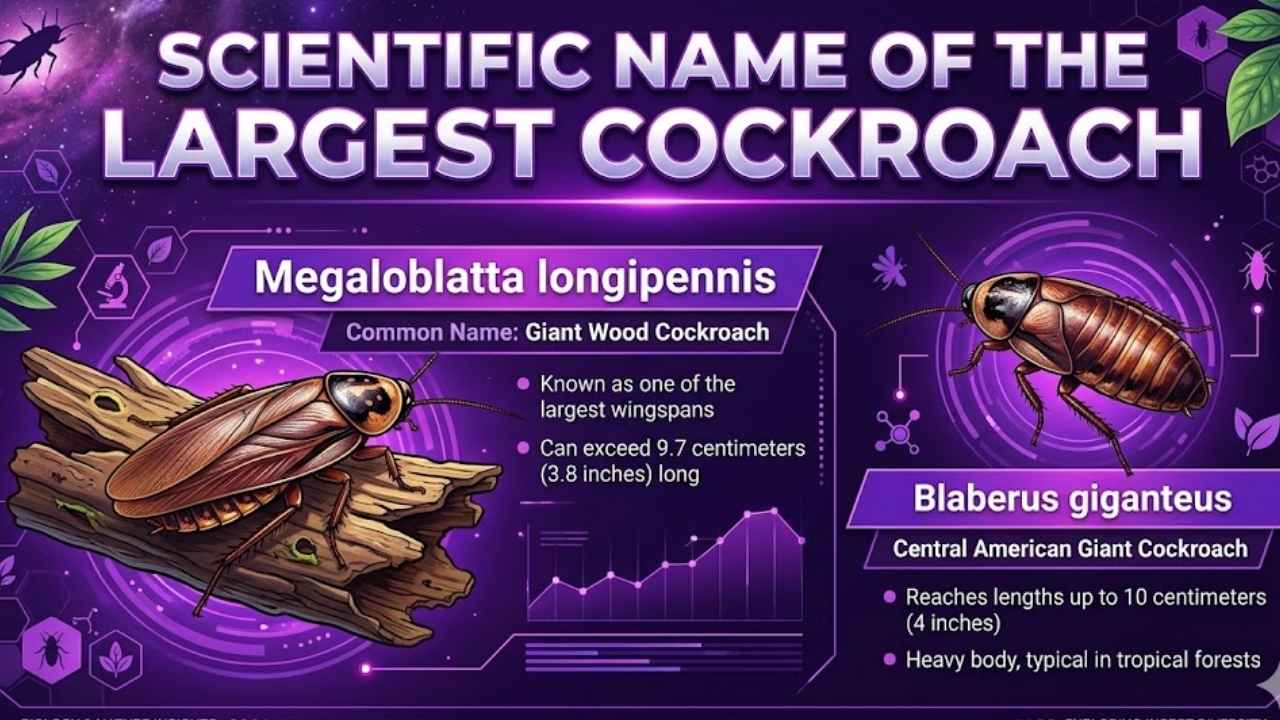
The scientific name of the largest cockroach is Megaloblatta longipennis. British entomologist Francis Walker first described it formally in 1868, based on a male specimen collected in Guayaquil, Ecuador. Originally classified under the genus Blabera, it was later moved to Megaloblatta to reflect its enormous size and distinctive morphology.
| Feature | Detail |
| Scientific Name | Megaloblatta longipennis |
| Family | Ectobiidae |
| Order | Blattodea |
| Subfamily | Nyctiborinae |
| First Described | 1868 by Francis Walker |
| Native Range | Colombia, Ecuador, Peru |
- “Megaloblatta” combines the Greek words megas (great/large) and blatta (cockroach), meaning “large cockroach.”
- “Longipennis” comes from the Latin longus (long) and penna (wing), meaning “long-winged.”
- The Guinness World Record recognizes this species as the world’s largest winged cockroach by both body length and wingspan.
- A preserved female specimen measures 9.7 cm in length and 4.5 cm in width.
- Its wingspan reaches up to 20 cm ,roughly the size of an adult human hand spread wide open.
The Largest Cockroach in the World: Physical Dimensions
If size alone makes you marvel at the insect world, then the largest cockroach in the world will genuinely leave you speechless. This isn’t the pest sneaking under your refrigerator ,this is a genuine heavyweight of the insect kingdom. Understanding its physical form helps you appreciate just how extraordinary Megaloblatta longipennis truly is.
The largest cockroach in the world sports an ovoid, robust body with an elliptical pronotum and broad tegmina covering its membranous hindwings. Its legs are sturdy and built for rapid movement across forest substrates. Long, filiform antennae with setose bases help the insect detect chemical signals in its humid, nocturnal habitat with remarkable precision.
| Measurement | Value |
| Maximum Body Length | 9.7 cm (3.8 in) |
| Maximum Body Width | 4.5 cm (1.75 in) |
| Maximum Wingspan | 20 cm (7.9 in) |
| Average Body Length | 8–9 cm |
| Record Specimen | Preserved female, Japan |
- Sexual dimorphism is visible ,males tend to have longer wings for better gliding, while females are wider with larger abdomens to carry egg cases.
- The wings are fully functional, enabling the cockroach to glide between trees ,a skill most cockroach species simply do not possess.
- The anterior femora bear numerous spines for gripping bark and climbing through dense vegetation.
- Its body color is dark brown to near-black, which blends naturally into the shadowy forest floor.
- Individuals from wetter, nutrient-rich forests like the Amazon basin tend to grow to even larger dimensions.
Taxonomic Classification of Megaloblatta longipennis
Understanding the taxonomy of the scientific name of the largest cockroach places it in a rich evolutionary context. Taxonomy isn’t just a naming system ,it reveals evolutionary relationships between species and helps scientists communicate across languages and disciplines. The classification of Megaloblatta longipennis connects it to a long lineage of ancient insects.
The scientific name of the largest cockroach sits within the order Blattodea, which includes all cockroaches and termites. The family Ectobiidae contains many flexible, adaptable species found across tropical environments. The subfamily Nyctiborinae, to which Megaloblatta belongs, consists of nocturnal forest-dwelling giants found mostly in the Neotropics of Central and South America.
- Kingdom: Animalia
- Phylum: Arthropoda
- Class: Insecta
- Order: Blattodea
- Family: Ectobiidae
- Subfamily: Nyctiborinae
- Genus: Megaloblatta
- Species: longipennis
The genus Megaloblatta was first described in 1887 by German entomologist Heinrich Dohrn. Four species exist within the genus: M. longipennis, M. blaberoides, M. insignis, and M. regina. Each occupies a distinct geographical range across Central and South America. M. longipennis remains the largest and most studied of the four.
Native Habitat: Where Does the Largest Cockroach Live?
It’s easy to assume that a cockroach this big would be found everywhere. But the largest cockroach in the world is surprisingly selective about where it calls home. Its habitat requirements are very specific, and that specificity is actually one of the reasons encountering one in the wild is such a rare event for researchers and adventurers alike.
Megaloblatta longipennis inhabits the tropical rainforests of Colombia, Ecuador, and Peru, primarily in humid lowland areas. It shows a strong preference for undisturbed primary forests over secondary growth or degraded habitats. Within these lush environments, it favors microhabitats including leaf litter, the undersides of fallen logs, bark crevices, tree holes, bromeliads, and curled dead leaves in the canopy.
- The species thrives in relative humidity levels of 77–88% year-round, typical of Neotropical lowland forests.
- Average temperatures in its habitat range between 25–30°C, keeping the cockroach active and healthy.
- It is a strictly nocturnal insect, spending daylight hours sheltered in bark crevices and suspended soils.
- Megaloblatta longipennis avoids open areas and exposed surfaces, preferring dense, layered canopy structures.
- Reports of this species in Panama are based on misidentifications of the closely related M. blaberoides.
Diet and Feeding Behavior of the World’s Largest Cockroach
You might assume that an insect this large would have an equally aggressive diet. But the largest cockroach in the world is actually a quiet, peaceful detritivore ,a creature that feeds on decomposing organic matter. Its eating habits play a surprisingly important ecological role in the rainforest ecosystem where it lives.
Megaloblatta longipennis follows a detritivorous diet, meaning it primarily feeds on dead and decaying plant material. Nymphs, in particular, consume rotting wood found in the rainforest canopy. Adult individuals feed on decaying leaves and other decomposing organic matter on the forest floor and in the canopy. This feeding behavior makes the species a critical nutrient recycler in its ecosystem.
- Rotting wood forms a key part of the nymphal diet, helping break down fallen trees.
- Adults consume decaying leaves, bark, and other plant debris that accumulates in forest microhabitats.
- Like many cockroaches, M. longipennis hosts Blattabacterium, an endosymbiont that converts nitrogenous waste into usable amino acids.
- This endosymbiotic relationship allows the cockroach to thrive on a nitrogen-poor, plant-based diet.
- The species does not invade homes, raid kitchens, or compete with humans for food in any way.
What Are the Other Largest Cockroaches in the World?
The scientific name of the largest cockroach by wingspan is Megaloblatta longipennis, but the world of giant cockroaches doesn’t stop there. Several other species compete for the title of “world’s largest” depending on how you define “large” ,whether by length, weight, or wingspan. Knowing the full picture gives you a much richer view of cockroach diversity.
The largest cockroach in the world by weight is actually a different species altogether ,the giant burrowing cockroach (Macropanesthia rhinoceros), native to Queensland, Australia. It can weigh up to 35 grams and reach 8 cm in length, making it the heaviest cockroach known to science. Meanwhile, Blaberus giganteus, the Central American giant cave cockroach, is another formidable competitor with females reaching 10 cm in body length.
| Species | Record | Native Region |
| Megaloblatta longipennis | Largest by wingspan (20 cm) | South America |
| Macropanesthia rhinoceros | Heaviest (up to 35 g) | Australia |
| Blaberus giganteus | Largest body (females ~10 cm) | Central America |
| Gromphadorhina portentosa | Loudest (hissing cockroach) | Madagascar |
| Periplaneta americana | Largest common pest species | Cosmopolitan |
- Macropanesthia rhinoceros is the only cockroach species known to live in permanent underground burrows.
- Blaberus giganteus prefers dark caves and humid rainforests, often found alongside bat populations.
- The Madagascar hissing cockroach (Gromphadorhina portentosa) hisses through abdominal spiracles to deter predators.
- Periplaneta americana is the largest common urban pest cockroach, averaging 4 cm in length.
- The smallest cockroach ever recorded (Attaphila fungicola) lives inside ant colonies and is barely visible to the naked eye.
How Does Megaloblatta longipennis Use Its Wings?
One of the most distinctive things about the scientific name of the largest cockroach ,Megaloblatta longipennis ,is what that name literally tells you: this insect has extraordinary wings. Most people think of cockroaches as ground-dwelling scavengers. But this giant defies the stereotype with a flying ability that sets it apart from almost every other cockroach species on Earth.
M. longipennis uses its large tegmina and membranous hindwings to glide effectively between trees in the rainforest canopy. This gliding ability helps the cockroach navigate its complex, multi-layered forest habitat. Males, with proportionally longer wings, tend to stay higher in the forest canopy, while the heavier females are less frequent fliers but still capable of impressive aerial movement.
- The 20 cm wingspan is the largest ever recorded for any cockroach species in the world.
- Unlike most roaches, M. longipennis actively uses its wings for controlled gliding ,not just as vestigial appendages.
- Males glide more frequently than females, likely as part of mate-finding and territory navigation.
- The broad, flat wing surface provides lift and directional control in dense forest air currents.
- The species also uses stridulation ,rubbing body parts together to produce sound ,to warn off predators.
What Is the Life Cycle of the World’s Largest Cockroach?
How Long Does Megaloblatta longipennis Live?
The scientific name of the largest cockroach represents an insect whose life cycle follows a familiar but fascinating pattern. Like all cockroaches, Megaloblatta longipennis undergoes hemimetabolous metamorphosis ,meaning it develops gradually through three distinct stages: egg, nymph, and adult. There is no pupal stage. The nymph essentially looks like a smaller, wingless version of the adult.
- Eggs are enclosed in an ootheca (egg case) that the female deposits in sheltered, humid locations.
- Nymphs emerge from the ootheca and begin feeding on rotting wood in the rainforest canopy immediately.
- Each nymphal stage (instar) sees the cockroach grow slightly larger before molting into the next stage.
- Wings develop only at the final adult stage, when the cockroach also becomes capable of reproduction.
- Specific lifespan data for M. longipennis in the wild is limited, but related giant species live 20+ months.
Why Is the Scientific Name of the Largest Cockroach Important to Science?
This question comes up more often than you’d expect ,and rightfully so. A scientific name isn’t just bureaucratic labeling. For researchers, conservationists, and educators worldwide, the scientific name of the largest cockroach functions as a universal communication tool. It eliminates confusion across dozens of languages and regional common names.
The scientific name of the largest cockroach also anchors the species within a broader system of biological classification that dates back to Carl Linnaeus’s binomial nomenclature system from the 18th century. When scientists study Megaloblatta longipennis, they immediately understand its family, its evolutionary relatives, its morphological characteristics, and its ecological niche ,all implied by the two-word Latin name.
- Binomial nomenclature ensures every species has one globally recognized name regardless of language or country.
- The name Megaloblatta longipennis communicates size and wing structure directly through its Latin-Greek etymology.
- Scientific names are stable and standardized ,unlike common names, which vary wildly by region.
- The Guinness World Records citation of this species by its scientific name confirms global recognition of its record-holding status.
- Proper scientific naming supports biodiversity research, conservation efforts, and accurate pest control classification.
How Does the Largest Cockroach in the World Help the Ecosystem?
People rarely associate cockroaches with ecological benefit. Yet the largest cockroach in the world contributes meaningfully to the tropical rainforest environment it inhabits. Far from being a pest or a threat, Megaloblatta longipennis functions as a quiet, efficient worker in the forest’s nutrient recycling system.
As a detritivore, M. longipennis breaks down decomposing wood, leaves, and plant matter in the rainforest. This decomposition activity releases vital nutrients back into the soil, supporting plant growth and maintaining the health of the broader ecosystem. Without decomposers like this giant cockroach, forests would accumulate dead organic matter far more rapidly than natural systems could manage.
- The species is non-venomous, non-aggressive, and poses zero threat to humans in its natural habitat.
- It does not carry diseases associated with common urban cockroach pests like Periplaneta americana.
- M. longipennis serves as a prey species for birds, lizards, bats, and other rainforest predators, contributing to food web dynamics.
- Its burrowing and foraging activities aerate the soil and improve moisture retention in the forest floor.
- Protecting this species means protecting primary rainforest habitats in Colombia, Ecuador, and Peru ,biodiversity hotspots of global importance.
What Makes the Largest Cockroach Different From Common Household Cockroaches?
How Is Megaloblatta longipennis Different From Periplaneta americana?
Many people assume all cockroaches are the same. They’re not. The scientific name of the largest cockroach ,Megaloblatta longipennis ,represents a species that shares almost nothing in common with the cockroaches you find in kitchens or bathrooms. The differences in size, habitat, behavior, and ecological role couldn’t be more dramatic.
The largest cockroach in the world lives exclusively in undisturbed tropical rainforests and has never been documented invading human homes. Common urban species like Periplaneta americana (the American cockroach) average just 4 cm in length ,barely a fraction of M. longipennis‘s size. Urban species are omnivorous opportunists that thrive on food scraps, grease, paper, and organic waste in human environments.
| Feature | Megaloblatta longipennis | Periplaneta americana |
| Body Length | Up to 9.7 cm | Average 4 cm |
| Wingspan | Up to 20 cm | Around 5–8 cm |
| Habitat | Tropical rainforest | Urban/suburban environments |
| Diet | Decaying wood and leaves | Omnivore, scavenges human food |
| Disease Risk | None known | Carries allergens and pathogens |
| Pest Status | Not a pest | Major household pest |
- M. longipennis is completely wild and has no known association with human dwellings or food supplies.
- Periplaneta americana was introduced to the Americas from Africa in the 17th century via trade ships.
- Common household cockroaches spread allergens and can contaminate food ,the largest cockroach in the world does neither.
- Urban pest cockroaches thrive in temperatures around 29°C in moist, dark spaces like sewers and basements.
- M. longipennis requires specific rainforest microhabitats and cannot survive in urban or suburban environments.
FAQs
What Is the Scientific Name of the Largest Cockroach?
The scientific name of the largest cockroach is Megaloblatta longipennis. Francis Walker first formally described it in 1868. It holds the Guinness World Record for the largest winged cockroach by both length and wingspan.
Where Does the Largest Cockroach in the World Live?
The largest cockroach in the world lives in the tropical rainforests of Colombia, Ecuador, and Peru. It prefers humid, undisturbed primary forests and is strictly nocturnal, hiding in bark crevices and leaf litter during daylight hours.
How Big Is the Largest Cockroach in the World?
The record-holding specimen of the largest cockroach in the world measures 9.7 cm in body length, 4.5 cm in width, and has a wingspan of up to 20 cm. This preserved female is held in a private collection in Yamagata, Japan.
Is the Scientific Name of the Largest Cockroach Dangerous to Humans?
No ,the scientific name of the largest cockroach, Megaloblatta longipennis, is not dangerous. It doesn’t bite, infest homes, carry diseases, or show any aggression toward humans. It is a shy, peaceful insect of the deep rainforest.
Why Is It Called Megaloblatta longipennis?
The name breaks into two parts. “Megaloblatta” means “large cockroach” from Greek (megas = large, blatta = cockroach). “Longipennis” means “long-winged” from Latin (longus = long, penna = wing). The scientific name of the largest cockroach perfectly describes its two defining physical traits.
What Is the Heaviest Cockroach in the World?
The heaviest cockroach in the world is Macropanesthia rhinoceros ,the giant burrowing cockroach from Australia ,weighing up to 35 grams. The scientific name of the largest cockroach by wingspan, however, remains Megaloblatta longipennis of South America.
Can the Largest Cockroach in the World Fly?
Yes ,the largest cockroach in the world can glide effectively using its massive wingspan of up to 20 cm. Males fly and glide more frequently than females. This ability to take to the air sets M. longipennis apart from most other cockroach species worldwide.
Conclusion
The scientific name of the largest cockroach ,Megaloblatta longipennis ,represents far more than a record in an entomology textbook. It’s a window into the extraordinary biodiversity of South America’s tropical rainforests. With a wingspan of up to 20 cm, a body length approaching 10 cm, and a lifestyle that contributes meaningfully to its ecosystem, the scientific name of the largest cockroach commands genuine respect.
The largest cockroach in the world isn’t a pest, a threat, or a horror story. It’s a remarkable creature that has evolved over millions of years to thrive in one of Earth’s most complex environments. Understanding the scientific name of the largest cockroach connects us to a much bigger story about biodiversity, taxonomy, and the invisible workers that keep rainforests healthy. Next time someone shudders at the word “cockroach,” share what you’ve learned here ,because not all cockroaches are created equal.